

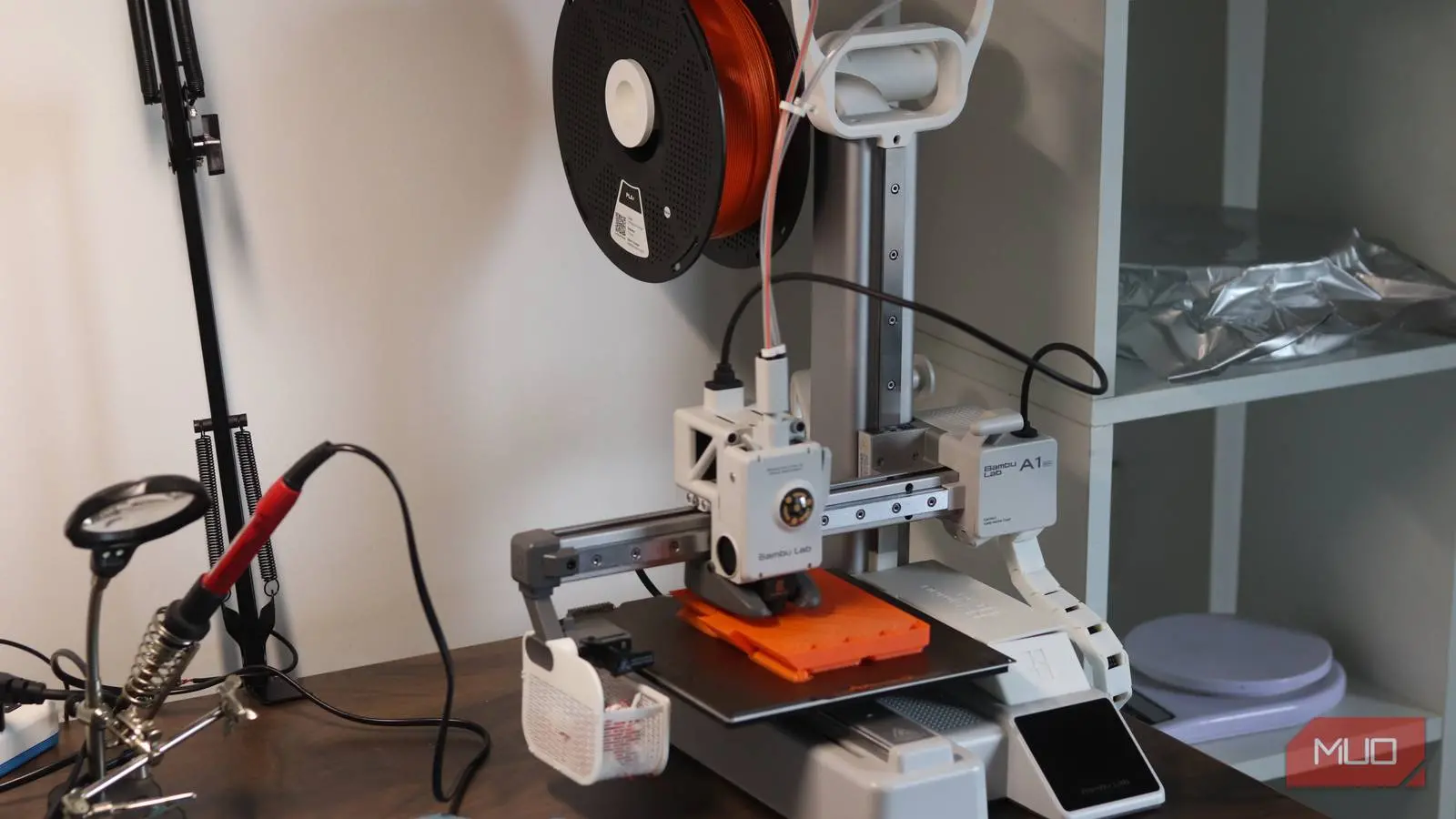
For years, I let an old memory talk me out of buying a 3D printer. My first job out of high school, back in 2017, involved repairing and maintaining two 3D printers. I got them running, and they worked as long as I was constantly tending to them. That experience hooked me on the possibilities of 3D printing, but it also planted a deep fear that owning one would mean endless tinkering, loud noise, and hours of babysitting prints. When I finally bought a Bambu Lab A1 Mini in 2026, I realized almost everything I believed was wrong.
The printer was never the problem
My early experience with 3D printing revolved primarily around the Wanhao Duplicator 3 — a massive, heavy, nearly industrial machine with a relatively small build plate but a bulky enclosure. The workflow was painful: I'd slice files on my PC, transfer them to a microSD card, walk over to the printer, and then spend time manually leveling the bed with a sheet of paper, hoping my eyeballed adjustments were precise enough. More often than not, they weren't. The printer also emitted a loud, constant whir that made it impossible to ignore.
When I started thinking about buying my own printer, I had a specific vision of where it would go: on my electronics workbench, right next to my actual work desk. Space was a real constraint, and I dreaded the idea of that noise becoming a permanent background to my workday. I assumed I'd have to choose between a cramped corner and constant distraction.
The Bambu Lab A1 Mini shattered that assumption within minutes. It has a tiny footprint, looks genuinely nice on the desk, and the only sound I hear during prints is the cooling fan. The motors are nearly silent. I now run print jobs all day long while sitting just a meter away, and I often forget the printer is even on. The old nightmare of a whirring, boxy machine has been replaced by a quiet, appliance-like device that fits naturally into my workspace.
Speed mattered less than I expected
My time-related fear had two layers. The first was print speed itself. I associated 3D printers with a glacial pace, where even a small part could take the better part of a day. The A1 Mini dismantled that assumption almost immediately. It prints a standard Benchy test boat in roughly 20 minutes at default speeds. Real-world functional prints — brackets, enclosures, organizers, custom parts for my electronics projects — finish in a fraction of the time older machines would have needed.
The second layer was the amount of attention a print would require from me. Turns out, the answer is almost none. Modern printers come with automatic bed leveling that runs before every print, eliminating the manual paper-trick ritual. Filament runout detection pauses the job if you run dry mid-print, so you don't come back to a ruined model. A built-in camera lets me check progress from my phone via the Bambu Handy app, or through a smart home dashboard if you integrate with Home Assistant.
I've started prints while hundreds of kilometers away from home and returned to a perfect model waiting on the bed. Once you maintain the printer and tune your filament profiles, 3D printing becomes a background process rather than a time hog. The old fear of standing over a printer for hours is simply obsolete.
Maintenance turned out to be mostly a myth
Beyond print time, I expected ongoing maintenance to quietly eat into my schedule. Back in the day, I considered myself lucky if I got through a full day of printing without unclogging a nozzle or re-leveling the bed on the Wanhao. I had mentally budgeted for bed calibration, nozzle clogs, belt tension checks, and other recurring chores as the inevitable price of owning a 3D printer.
In practice, the A1 Mini has asked very little of me. In the 134 hours of total printing time since I got it, the only thing I've done is calibrate my filament — and even that wasn't strictly necessary. Generic PLA profiles worked well enough with filament from various brands. Modern printers from Creality, Elegoo, and Prusa have also moved in this direction, becoming more like home appliances than hobbyist projects.
The one area where I'd temper expectations is multi-color printing with the AMS or AMS Lite. I skipped it because of the significant filament waste it produces. Multi-color prints also take considerably longer and consume more material than single-color jobs. But for my everyday prints — custom ESP32 enclosures, mounts, cosmetic parts, replacement brackets, and similar functional items — the experience has been remarkably low friction.
The biggest mistake was waiting so long
I bought my printer just before Bambu Lab started adopting some controversial business practices, but regardless, they make a very good machine. The broader point is that the entire 3D printing landscape has changed. Modern machines no longer demand constant attention. You configure them once, make a few adjustments to defaults or simply trust them, and they work. Basic maintenance like cleaning the build plate and lubricating the rails is enough to keep things running smoothly for months.
I was holding on to a mental image of 3D printing from nearly a decade ago, and I hadn't updated it as the technology evolved. If your hesitation, like mine, is really about time — both the time prints take and the time and skill the machine demands of you — 3D printing has addressed both sides of that equation. It's fast, reliable, and it gets out of your way. I wish I had stopped waiting much sooner, because the years of overthinking cost me more than any printer ever could have.
Source:MakeUseOf News