

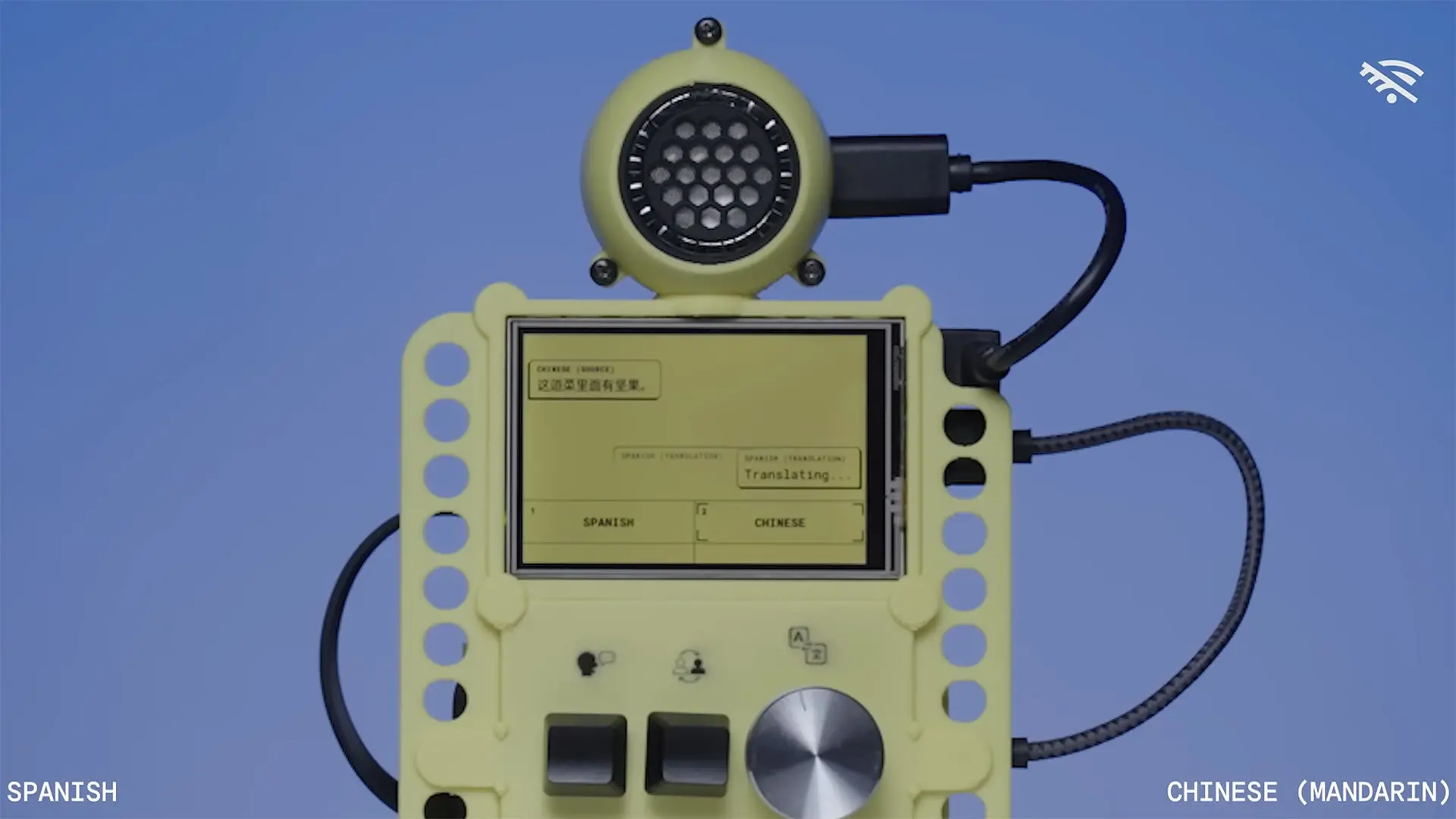
Google's Gemma family of open models has long promised to bring powerful AI capabilities to edge devices. A recent project by a team of Google engineers takes that promise to the next level with a fully offline, portable AI translator built around the Gemma 4 E4B model and a Raspberry Pi 5. The device is designed to be simple yet functional, featuring a touchscreen display, a microphone, a speaker, a push-to-talk button, and a rotary knob for switching between languages. Everything runs locally, making it ideal for travel, fieldwork, or privacy-sensitive environments.
The entire build is open source, with the software code and 3D-printed enclosure files shared on GitHub. This means anyone with a Raspberry Pi 5, a few electronic components, and a 3D printer can recreate the translator at home. The project also highlights the capabilities of Google Antigravity, a development platform reportedly used by the engineers to streamline the creation process.
Key Facts at a Glance
- A team of Google engineers created a portable AI translator using the Gemma 4 E4B model running on a Raspberry Pi 5.
- The translator works fully offline after initial setup, requiring no cellular or Wi-Fi connectivity.
- It includes a touchscreen display, microphone, speaker, push-to-talk button, and a knob to change languages.
- The software uses LiteRT-LM to run the Gemma 4 E4B model and Moonshine text-to-speech for audio output.
- Google Antigravity was used during development, and all code plus 3D-printing files are available on GitHub.
What Is Gemma 4 E4B?
Gemma is Google's family of lightweight, open-weights AI models designed to run on resource-constrained hardware like smartphones, laptops, and single-board computers. The Gemma 4 E4B is one of the latest iterations in this lineup, offering a balance between model size and performance. The "E4B" designation likely refers to the number of active parameters (around 4 billion) or a specific architectural variant optimized for edge deployment. Unlike larger cloud-based models such as Gemini, Gemma models are intended to be run locally, giving developers full control over the input and output data.
The Gemma 4 E4B model is particularly well-suited for translation tasks. It has been trained on a diverse corpus of multilingual text, allowing it to understand and translate between a wide range of languages. Because it is a relatively compact model, it can operate on a device like the Raspberry Pi 5 without demanding excessive memory or processing power. This makes it an excellent choice for a standalone translator that needs to work in remote locations where cloud connectivity is unavailable.
Hardware and Design
The physical design of the translator is one of the most appealing aspects of the project. The engineers created a custom 3D-printed housing that encloses the Raspberry Pi 5 and the peripheral components. The enclosure is designed to be compact and portable, fitting comfortably in one hand. On the front, there is a small touchscreen display that shows the source text, the translated text, and the current language pair.
The device also includes a push-to-talk button, which the user presses while speaking into the onboard microphone. This helps the device know when to start and stop recording audio, reducing background noise and improving transcription accuracy. A rotary knob on the side or top allows the user to cycle through supported languages, making it easy to switch between, for example, English and Spanish or French and Japanese.
Inside the enclosure, the Raspberry Pi 5 acts as the brain of the operation. The Pi 5, released in late 2023, features a quad-core Arm Cortex-A76 processor running at 2.4 GHz, making it significantly more powerful than its predecessors. It also supports up to 8GB of RAM, which is sufficient for running a compact language model like Gemma 4 E4B. The Pi 5's GPIO and USB interfaces make it easy to connect a microphone, speaker, and other peripherals.
How the Translator Works
The translation process begins when the user presses the push-to-talk button and speaks a phrase. The microphone captures the audio, which is then processed by a speech recognition system. The project uses Moonshine for text-to-speech output, but speech recognition may be handled by a separate component. Interestingly, the engineers used LiteRT-LM to run the Gemma 4 E4B model. LiteRT-LM is likely a runtime or inference engine designed to execute language models efficiently on edge hardware.
Once the speech is converted into text, the Gemma 4 E4B model translates it into the target language. The translated text appears on the touchscreen display, and Moonshine converts it into speech that is played through the speaker. The entire pipeline runs locally, meaning no data is sent to the cloud. This is a significant advantage for users who need to translate sensitive or confidential information without worrying about privacy breaches.
Why Offline Translation Matters
Most translation services, including popular apps like Google Translate, rely heavily on cloud servers to process speech and text. While this approach can produce highly accurate results, it requires a stable internet connection. In many parts of the world, reliable connectivity is not a given. Travelers, journalists, aid workers, and field researchers often find themselves in remote areas where cellular or Wi-Fi networks are unavailable. An offline translator addresses these needs perfectly.
Offline translation also offers benefits in terms of privacy and latency. When a translation is processed locally, there is no risk of the audio or text being intercepted or stored on third-party servers. Additionally, on-device processing can be faster than a round trip to a cloud server, which is helpful for real-time conversations.
The Raspberry Pi-based translator is not the first offline translation device ever created, but it is one of the most accessible. With the open-source code and 3D-printed files, hobbyists and developers can build their own without needing to purchase expensive proprietary hardware. The project also serves as a proof of concept for what is possible with modern edge AI models.
Building Your Own Translator
If you are interested in building your own offline AI translator, the resources are freely available on GitHub. You will need a Raspberry Pi 5, a compatible touchscreen display, a microphone, a speaker, a push-to-talk button, a rotary encoder (for the knob), and access to a 3D printer. The GitHub repository includes the source code, the 3D model files for the enclosure, and step-by-step instructions for assembly.
The software stack is built on LiteRT-LM, which manages the model execution on the Raspberry Pi. You will also need to download the Gemma 4 E4B model weights from Google's official repository. The Moonshine text-to-speech engine is used for audio output. The code is written in Python, and the user interface is designed to work with the touchscreen display.
One of the strengths of this project is its modularity. You can customize the design to suit your own needs, whether that means adding more languages, changing the enclosure shape, or integrating a battery pack for true portability. The open-source nature of the project encourages experimentation and iteration.
The Role of Google Antigravity
Google Antigravity is mentioned as the development environment used by the team. While details about Antigravity are still emerging, it is believed to be an AI-powered development platform that assists engineers in writing code, designing interfaces, and integrating hardware. The fact that the team used Antigravity for this project suggests that Google is positioning it as a tool for rapid prototyping and embedded AI development.
By leveraging Antigravity, the engineers were able to bring the project to life quickly. The platform may have helped with tasks like generating the UI code for the touchscreen, optimizing the model inference, or even debugging the hardware interactions. This is another example of how AI tools are becoming integral to the software development workflow.
The Bigger Picture
This portable translator is more than just a clever DIY project. It demonstrates that sophisticated AI applications can run on affordable, low-power hardware. The Raspberry Pi 5, which costs around $60 for the basic version, is capable of running a multilingual translation model entirely offline. This opens up a world of possibilities for education, healthcare, and accessibility in underserved communities.
Furthermore, the project showcases Google's commitment to open AI. By releasing the Gemma models under a permissive license and providing the code for this translator, Google is empowering individuals and small teams to build their own AI solutions. It is a stark contrast to closed, cloud-only AI services that keep users locked into a platform.
As edge computing and open-weight models continue to evolve, we can expect to see more projects like this. The boundaries between online and offline AI are blurring, and devices like this translator are at the forefront of that shift.
Source:Android Authority News