

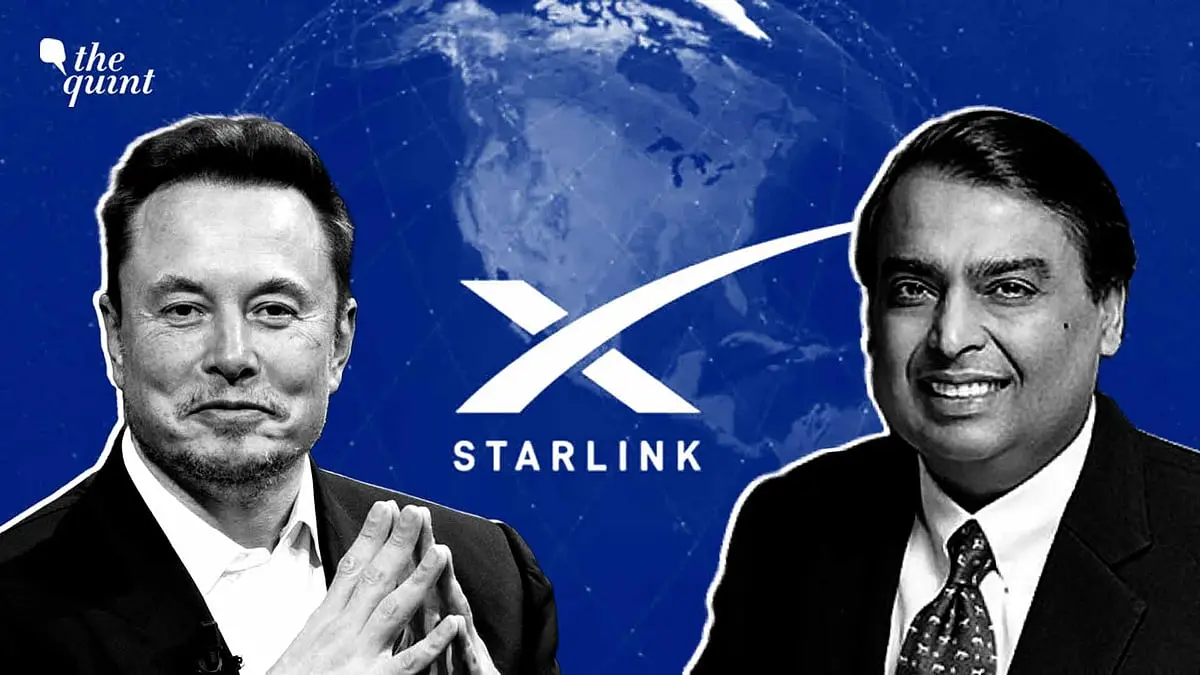
Headline and Key Facts
- Headline: Elon Musk's Ambani Jibe: Starlink's Delays Don't Prove Bias. Jio Is Waiting Too
- Core claim: Musk blamed 'certain oligarchs' for blocking Starlink and asked whether Mukesh Ambani is the real boss of India.
- Government response: The Ministry of Communications called the satellite communication framework fair and non-discriminatory and said all three applicants - Jio SES, Starlink, and OneWeb - are at broadly the same regulatory stage.
- Licence status: Starlink already holds a permit and space-regulator authorisation; it is waiting only for security clearance, according to a senior government adviser.
- Key context: The approvals Starlink still awaits are ones its rivals are also waiting for. Whether the process is fast enough is a separate but fair question.
Musk's escalating public attack
When a licence application stays in process for years, frustration is understandable, and so is the search for an explanation. Elon Musk has offered one. On Wednesday, 7 October, he blamed 'certain oligarchs' for blocking Starlink. The next day he asked, 'Is Ambani the real boss of India?' On Friday, 9 October, he went further, addressing 'Prime Minister Ambani' in a mock apology and asking whether India's richest man would let Starlink compete.
The charge is serious: that a domestic rival is shaping the rules that govern its competitor. It deserves to be tested against the record rather than accepted or dismissed on reflex. Musk's comments turned a regulatory delay into a geopolitical and business spectacle. They also put a spotlight on India's satellite communication licensing regime, the role of Reliance Jio, and the broader contest over how satellite spectrum should be assigned.
What the government says
The government has responded firmly. The Ministry of Communications called the satcom framework fair and non-discriminatory, described claims otherwise as baseless, and said all three applicants - Jio SES, Starlink, and OneWeb - are at broadly the same regulatory stage. A senior adviser in the Ministry of Information and Broadcasting added that neither Musk nor Starlink is entitled to preferential treatment. In his account, Starlink already holds its permit and space-regulator authorisation, and is waiting only for security clearance.
On that point the record supports the government. Starlink is not being denied a licence; it holds one. The approvals it still awaits are ones its rivals are also waiting for. Whether the process is fast enough is a separate question, and a fair one. The distinction matters because Musk's rhetoric suggests a deliberate blockade aimed at one company. The administrative reality appears more mundane: multiple applicants navigating the same security and compliance steps.
Why satellite communication licensing is slow
India's satellite communication sector sits at the intersection of telecom, space, security, and foreign policy. A company seeking to offer broadband from low-earth orbit must clear several layers. It needs a telecom licence or authorisation under the Department of Telecommunications. It needs approval from the space regulator, now known as the Indian National Space Promotion and Authorisation Centre, or IN-SPACe. It needs clearance for gateways and ground stations. It must satisfy security agencies about data localisation, lawful interception, and the nationality of its ownership. Each step involves different ministries and departments.
For foreign satellite operators, the security clearance stage is especially sensitive. Satellite broadband can serve remote areas, but it can also bypass terrestrial networks and raise surveillance concerns. India has long required telecom operators to meet strict security conditions. Those conditions are not unique to Starlink. They apply to Jio SES and OneWeb as well. That is why the government's claim that all three are at broadly the same stage is plausible on its face.
The process is also slow because India's satcom policy has been evolving. For years, satellite services were governed by older licensing rules designed for a different era. The government introduced reforms to streamline approvals and encourage private participation. But implementation has taken time. Ministries have had to interpret new rules, coordinate with the space regulator, and resolve questions about spectrum allocation. Those questions are not technical alone. They involve money, market power, and national security.
The spectrum auction debate
One of the most contentious issues is how satellite spectrum should be allocated. Spectrum is the radio frequency used to communicate with satellites. Terrestrial telecom operators in India have traditionally acquired spectrum through auctions. Satellite operators, including Starlink, have argued that satellite spectrum should be allocated administratively, as is common in many other countries. Their argument is that satellite spectrum is shared, not exclusive, and that auctions would raise costs and delay deployment.
Reliance Jio, on the other hand, has advocated for an auction. Its argument is that a level playing field requires the same rules for terrestrial and satellite services, especially when satellite broadband could compete directly with fibre and mobile broadband. The debate became a proxy for a larger question: will India treat satellite internet as a complement to existing networks or as a rival to them?
Musk's public comments did not explicitly mention the auction debate in the original dispute, but they fit into that broader context. When he says 'certain oligarchs' are blocking Starlink, he is pointing at a domestic corporate interest that has lobbied on spectrum policy. The government, however, distinguishes between policy lobbying and licensing decisions. It says the framework is non-discriminatory and that no applicant is being singled out.
Jio, OneWeb, and the competitive landscape
Reliance Jio has partnered with SES to form Jio SES, a joint venture aiming to provide satellite broadband in India. OneWeb, now partly owned by Bharti Enterprises, is another major player. Both have global constellations and both want to serve Indian consumers, enterprises, and government agencies. Starlink is the most visible because of Musk's profile and because SpaceX has already launched thousands of satellites.
The three applicants are not identical. Starlink operates a low-earth orbit constellation with a large consumer base in other countries. OneWeb focuses more on enterprise, government, and remote connectivity. Jio SES combines Reliance's telecom muscle with SES's satellite fleet. They may compete for similar customers, but their business models and timelines differ. That makes the 'same regulatory stage' claim both accurate and slightly misleading. They may be at the same stage of licensing, but they are not equally ready to launch services.
Still, the licensing process is designed to be technology-neutral and applicant-neutral. If Starlink is waiting for security clearance, and if Jio SES and OneWeb are also waiting for security clearance, then the delay is not evidence of bias against Starlink. It is evidence of a system that takes time. The system may be too slow. It may be overly cautious. It may need reform. But slowness alone does not prove that Ambani or any other oligarch controls the outcome.
What Musk's intervention reveals
Musk's intervention reveals more about his approach to regulation than about India's internal politics. He has often used his public platform to pressure governments. In Brazil, he clashed with authorities over content moderation and satellite services. In Europe, he has criticized regulatory decisions. In India, he has now personalized a licensing delay by naming Ambani and mocking the prime minister. That style can mobilize attention, but it can also harden positions.
For Indian regulators, the challenge is to demonstrate that decisions are based on law and security, not on corporate pressure from either side. For Starlink, the challenge is to show that it can meet India's security requirements without special treatment. For Jio and OneWeb, the challenge is to avoid the appearance that they are using the regulatory process to hobble a competitor. The government's public statements try to strike that balance.
The real test: speed versus fairness
The original dispute is not about whether Starlink should be allowed to operate in India. The government says it holds a licence and has space-regulator authorisation. The dispute is about how long the remaining clearances take and whether those delays are fair. If all three applicants are waiting, then the issue is administrative capacity and inter-ministerial coordination. If one applicant is moving faster than others, then questions about bias become more serious.
The government has said the framework is fair and non-discriminatory. It has also said no one is entitled to preferential treatment. Those are the right principles. The test is whether the process reflects them in practice. A fair process can still be slow. A slow process can still be fair. Musk's claim that 'certain oligarchs' are blocking Starlink does not survive contact with the record as presented by the government. But the record also does not answer every question about why the process takes so long.
India's satellite broadband market is potentially enormous. It could connect remote villages, support disaster response, and provide competition to terrestrial networks. It could also create new security risks and market concentration. The licensing decisions will shape that market for years. That is why the process deserves scrutiny. It is also why the process should not be short-circuited by a public feud between billionaires.
For now, the facts point to a familiar regulatory bottleneck rather than a proven conspiracy. Starlink has its permit and space-regulator authorisation. It awaits security clearance. Jio SES and OneWeb are in broadly the same position. The approvals they all need are not favors granted to one company over another. They are conditions imposed on all. Whether those conditions can be met faster is a legitimate question. Whether they prove bias is a different question, and the evidence so far does not support the accusation.
Source:TheQuint News