

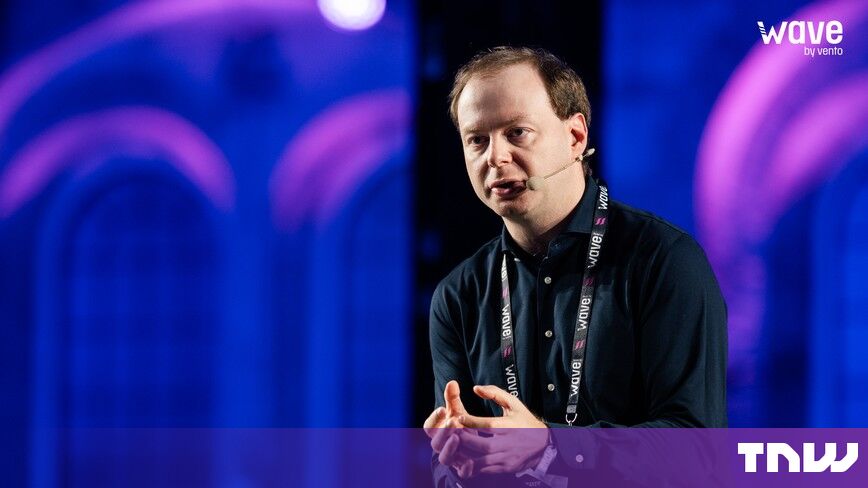
Miro co-founder and chief executive Andrey Khusid has warned that adding artificial intelligence to existing teams and operational systems will not deliver the productivity gains that companies expect. Speaking at Wave by Vento in Turin on Wednesday, Khusid said organisations need to redesign how work happens from the ground up rather than layering AI on top of old processes.
"One of the big challenges is how not to put AI on top of the existing teams or operational systems, but actually, from first principles, design the workflow and then only add humans to add value on top of that workflow," he said during a session titled "Thinking Together in the Age of AI".
His appearance in Italy came a month after Milan-based Bending Spoons agreed to buy Miro for $1.355bn. Bending Spoons expects the deal to close in the fourth quarter, subject to approvals. Miro has about $600m in annual recurring revenue, according to Bending Spoons. It was valued at $17.5bn in January 2022, when it raised $400m. Khusid said he could not talk about the transaction yet. He added that he was happy to be in Italy, describing it as "maybe a new home for Miro".
Why personal AI gains do not add up
Most people now use AI tools such as Claude or ChatGPT every day, Khusid said. The hard part is changing how entire companies operate. Individual productivity gains are visible and often impressive, but they do not automatically translate into better outcomes for a team, a department, or a business.
Companies run on complex workflows, he explained, in which work passes from one person to the next. Each person holds a different piece of the context, and that context is rarely in one place. The first job is to bring that context together so teams can work from it. Without a shared understanding of the work, AI tools simply produce faster fragments that do not connect.
Spreading AI across an existing operating model will not give the gains people expect, he said. In some areas, Miro set up parallel teams that did the same work with AI. It built the process around those teams, then scaled it to the rest of the company. That approach allowed the company to learn what worked before trying to force AI into every corner of the organisation.
The lesson is that AI adoption is not a software installation. It is an operating-model change. If a company keeps its old handoffs, approvals, meetings, and incentives, AI will often accelerate existing friction. It may help one person finish a task sooner, but the task still waits for the next person, the next meeting, or the next approval. The bottleneck moves rather than disappears.
More voices, more noise
AI gives quieter people a better way to share their ideas, Khusid said. They can quickly turn a prompt into a prototype that others can see. That can bring new perspectives into a team and reduce the advantage held by people who are simply more comfortable speaking in meetings.
But it also creates far more content, he warned. If everyone throws AI output at their team, it overwhelms the team and slows everyone down. The problem is not only volume. It is the lack of ownership. When a document, a plan, or a prototype arrives without a clear human owner, colleagues cannot tell what matters, what is accurate, or what decision is being requested.
In June, the Harvard Business Review warned about AI "workslop" in companies. The term describes the growing flow of polished but low-value material generated by AI and passed between colleagues. Khusid's answer is accountability: each person has to own every piece of what they bring. AI can help produce the work, but a human must stand behind it.
That principle applies to leadership as well. Managers cannot ask teams to adopt AI while tolerating a flood of unowned output. They need to set norms about what good AI-assisted work looks like, who reviews it, and how it connects to decisions. Otherwise, the same tools that promise speed become another source of organisational drag.
Intelligence at the centre
Organisations were built around people and hierarchy, with knowledge held by individuals, Khusid said. In new companies, a central intelligence knows almost everything that happens. People tap into it to decide and move fast. That intelligence may be a combination of data systems, AI models, and shared workspaces, but the key is that it gives everyone a common view of the business.
Established companies have to rebuild their own intelligence infrastructure and rethink which roles they need, he said. Startups built this way move faster and decide better, which creates urgency for everyone else. In July, UK figures showed businesses had tripled their AI adoption, though most still used it only lightly. The gap between experimentation and redesign remains wide.
For large organisations, the challenge is cultural as much as technical. Knowledge that once sat with senior employees must become accessible without losing accountability. Middle management layers that existed mainly to move information may need to change. New roles may emerge around context engineering, AI oversight, and workflow design. The companies that treat these changes as a redesign project, rather than an IT upgrade, are more likely to capture value.
A 15-year-old company built with AI
Miro is 15 years old. Much of its code is already written with AI help, Khusid said, and the company has merged systems to give AI better context. He said there has been little disruptive change in models lately. It is already clear what they can do over the next three years. So Miro builds around that rather than chasing every release.
That comment points to a broader shift in how technology companies approach AI. The first phase was often about access: which model, which vendor, which API. The next phase is about integration: how AI fits into existing products, data flows, and customer workflows. For Miro, that means using AI to understand context across boards, documents, and conversations, not simply adding a chatbot to a sidebar.
Humans and AI agents already work side by side in startups and large companies, he said, but people stay accountable. Miro is building a system where people and agents work on the same canvas. Within three years, he expects Miro to rely more on voice and conversation, with visual decision-making as the main way teams decide.
The vision is not that AI replaces the team. It is that AI becomes part of the team's working surface. Agents can gather context, suggest options, and prepare materials, while humans set direction, judge trade-offs, and take responsibility. The canvas becomes a shared place where both kinds of participants can see the same problem and contribute to the same decision.
Khusid said Miro started in 2011 but only saw meaningful traction in 2016. His advice to founders is to work on something they love and to listen to their own intuition. That journey, from a slow start to a company with hundreds of millions in recurring revenue, also reflects the long arc of collaboration software. Tools that once digitised whiteboards now face a new design question: how should work be organised when AI can participate in it?
For Khusid, the answer is not to bolt AI onto the side of a legacy process. It is to redesign the process first, decide where humans add unique value, and then let AI and agents operate within that structure. The productivity gains, he argues, will come from the redesign, not from the tool alone.