

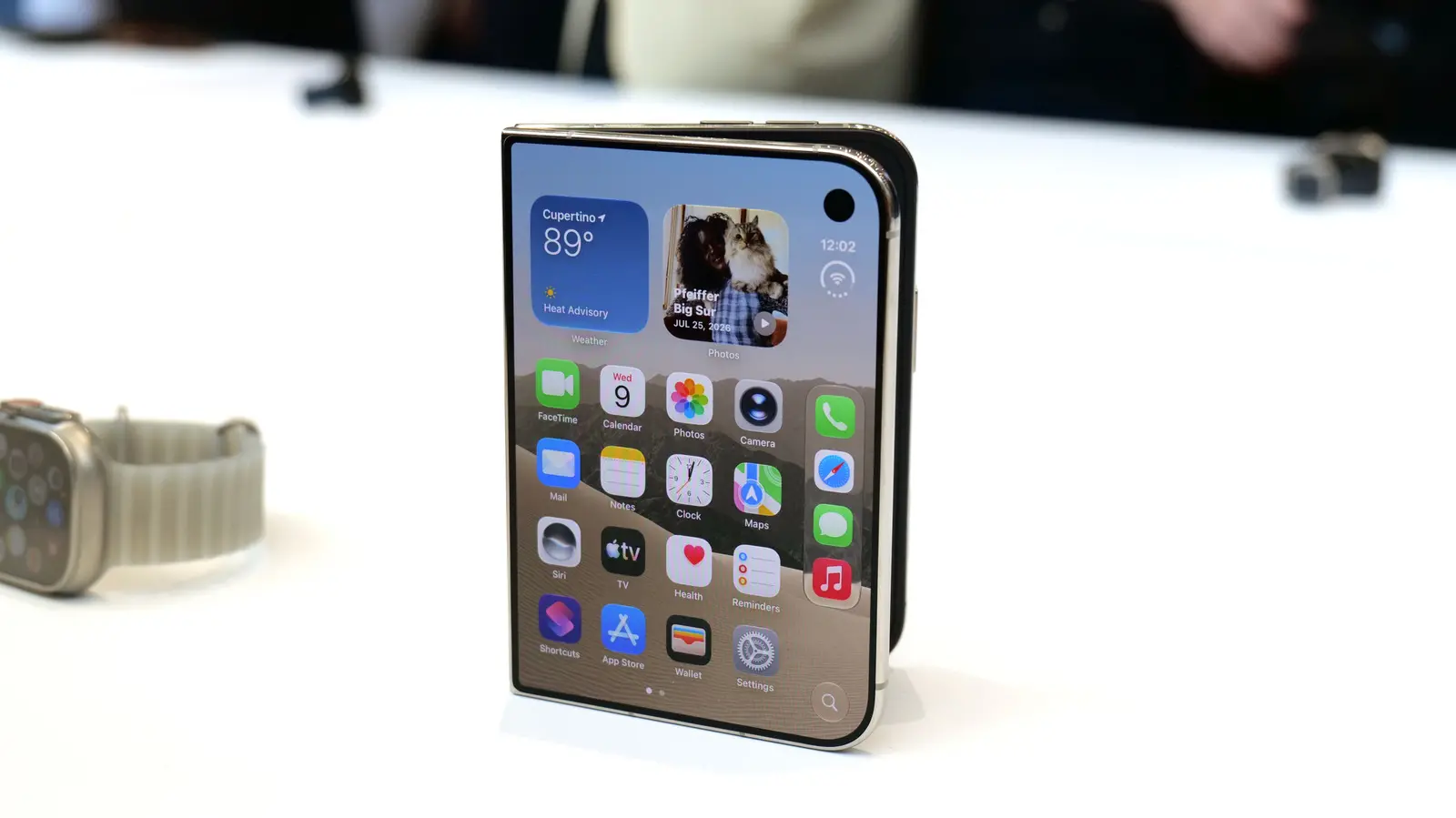
iPhone Duo hands-on: Apple's most exciting device in a decade
Apple has spent years watching rivals experiment with foldable phones, and now the company is finally entering the category with the iPhone Duo. The device arrives almost a decade after the iPhone X, the handset that reset Apple's design language with an edge-to-edge screen and the removal of the home button. The iPhone Duo aims to do something similar for the foldable era, blending Apple's familiar polish with a new form factor that opens into a tablet-sized canvas. Based on an early hands-on, it may be the most interesting Apple gadget in nearly ten years.
The headline feature is obvious: the iPhone Duo folds. It uses a 5.4-inch external OLED display for quick interactions and a larger 7.6-inch flexible OLED panel on the inside for media, multitasking, and productivity. The design inevitably invites comparisons to the original Pixel Fold, but Apple has refined the chassis with rounded edges that make the phone easy to open. The transition animation between the cover screen and the inner display is especially impressive, with subtle gradient and depth-of-field effects that make the switch feel almost seamless.
Key facts at a glance
- Apple's first foldable phone is called the iPhone Duo.
- It has a 5.4-inch external OLED screen and a 7.6-inch flexible OLED inner display.
- The frame is titanium and carries an IP68 dust and water resistance rating.
- It measures 11.3mm when closed and weighs 254 grams, making it thicker and heavier than the Galaxy Z Fold 8.
- Buttons include a lock key with TouchID, a dedicated camera control, and a volume rocker.
- The inner display has a matte nano texture that reduces reflections and disguises the crease.
- An under-display FaceTime camera is nearly invisible when not in use.
- Apple Pencil support works across both screens, though stylus testing was not possible at the demo.
- Rear cameras include a 48MP Fusion main sensor with 2x telephoto output at 12MP and a 48MP ultra-wide.
- Software supports split-screen multitasking, drag-and-drop, and saved app pairs.
- Pricing is $100 less than a Galaxy Z Fold Ultra and $100 more than a Galaxy Z Fold 8.
- Pre-orders begin October 16 at 8AM ET, with sales starting October 23.
That list only hints at the experience. The iPhone Duo is not simply a spec sheet. It is Apple's attempt to answer a question that has hung over the mobile industry for years: what happens when a phone becomes a tablet without becoming a burden? The answer, at least in this first generation, is a device that borrows heavily from the best foldables already on the market, then wraps those ideas in Apple's distinctive hardware and software language.
Design: titanium, weight, and button placement
The iPhone Duo's titanium frame gives it a premium feel, and the IP68 rating means it should survive dust and water exposure just like the best flagship phones. The rounded sides are comfortable to grip and make the folding action feel natural. When the phone is closed, however, it is noticeably chunky. At 11.3mm thick and 254 grams, it is significantly heavier and thicker than Samsung's Galaxy Z Fold 8, which weighs 201 grams and measures 9.7mm when closed. That difference may not sound dramatic on paper, but it is immediately apparent in the hand. Apple representatives reportedly asked that side-by-side comparisons with the Galaxy Z Fold 8 and the original Pixel Fold not be photographed during the demo, which suggests the company is aware that size and weight are potential talking points.
The button layout is thoughtful. There is a lock key with built-in TouchID, a dedicated camera control, and a volume rocker. Placing the volume rocker on the top edge initially seems unusual, but it makes sense for a device that shifts frequently between portrait and landscape orientations. The iPhone Duo is also adept at sensing how far it is open and at what angle. It supports tent and tabletop modes, allowing the phone to become a clock or a standalone calendar when partially folded. The ability to use the phone while it is only partially bent should appeal to readers who prefer a more natural ebook experience. Switching from Face ID to a side-mounted TouchID sensor is another smart decision. For anyone who has used a foldable with a fingerprint reader on the power button, TouchID remains a fast and reliable way to unlock the phone and authorize purchases.
Displays: matte texture, faint crease, and a hidden camera
The inner display is one of the iPhone Duo's most impressive elements. It features a heavy matte nano texture that serves multiple purposes. First, it almost completely eliminates reflections, which makes the screen easier to read in bright environments. Second, it helps disguise the crease that inevitably runs down the middle of a foldable panel. There is still a crease, but it is faint. In practice, it is often easier to feel with a fingertip than to see with the eyes. That is a meaningful achievement, because crease visibility has been one of the most common criticisms of foldable phones since the category began.
Apple has also included an under-display FaceTime camera that nearly disappears when it is not in use. Samsung experimented with similar technology on the Galaxy Z Fold 3 back in 2021, but the company appears to have moved away from it in more recent models. Seeing it on the iPhone Duo is therefore both a technical feat and a bragging point. The camera is only visible if you look closely and notice that the circular group of pixels above the sensor is glossy rather than matte like the rest of the main display. This kind of detail is exactly what Apple hopes will separate the Duo from its rivals.
The outer screen is shiny, but the matte interior should help stylus input feel more natural. The iPhone Duo supports the Apple Pencil across both screens, which opens the door to note-taking, sketching, and precision editing. Unfortunately, no Apple Pencils were available at the demo area, so the stylus experience could not be properly tested. Even so, the combination of a matte inner panel and Apple Pencil support suggests that the Duo is meant to be more than a phone that folds; it is meant to be a portable creative tool.
Cameras: capable, but missing a longer zoom
Around the back, the iPhone Duo has two rear cameras. The main sensor is a 48-megapixel Fusion camera that can also capture 2x telephoto shots at 12 megapixels. There is also a 48-megapixel ultra-wide camera. In isolation, this is a strong kit that should take crisp photos in a range of lighting conditions. It does not offer the variable aperture controls found on the iPhone 18 Pro line, but that omission is acceptable for a first-generation foldable. The bigger issue is zoom. Competing devices such as the Galaxy Z Fold 8 Ultra offer a longer dedicated telephoto lens, and the iPhone Duo does not match that reach. For users who rely on optical zoom for photography, that could be a reason to hesitate.
One design detail stands out: the rear camera module spans the width of the phone's back panel. That allows the iPhone Duo to rest neatly on a table with zero rocking or wobbling. It is a small touch, but it is the kind of attention to detail that makes a device feel considered rather than rushed.
Software: the real Apple advantage
Perhaps the most impressive part of the iPhone Duo is its software. Multitasking feels slick and refined, which helps explain why Apple waited so long before releasing a foldable. There are several ways to enter split-screen mode. You can touch and hold an app icon and then select the split-screen option. Alternatively, you can swipe up from the bottom of the display and drag apps to the left or right. Once in split-screen, you can drag and drop photos and files from one app to another. You can also hold the small tab in the middle of the split-screen view to create dedicated app pairs for faster multitasking in the future. The iPhone Duo offers many of the productivity features people love from iPadOS, but in a device that is easier to carry and use on the go.
This software polish is where Apple's foldable may have an edge over Android competitors. Samsung, Google, and Motorola have all released foldables with multitasking features, but the iPhone Duo's integration feels more cohesive. The company has a long history of designing hardware and software together, and that advantage is visible in the way apps resize, the way the transition animation flows, and the way the device adapts to different folding angles.
Competitive context and pricing
For its first foldable, Apple has cleverly collected many of the best features from its rivals and placed them in an elegant handset that is unmistakably Apple. It has IP68 dust and water resistance like the Pixel 11 Pro Fold. It has a beautiful main panel with an under-display camera and a matte finish that is even less reflective than the Galaxy Z Fold 8. Its software feels more polished and integrated than what Samsung, Google, and Motorola have achieved on Android. And the price is aggressive: the iPhone Duo costs $100 less than a Galaxy Z Fold Ultra, though it is $100 more than a standard Galaxy Z Fold 8. That makes it a compelling package for iPhone fans who have watched foldables flourish on the other side of the mobile operating system divide. The Duo may be late, but it can hang with the best of them.
Availability
The iPhone Duo is available for pre-order starting October 16 at 8AM ET, with official sales slated for October 23.
Source:Engadget News