

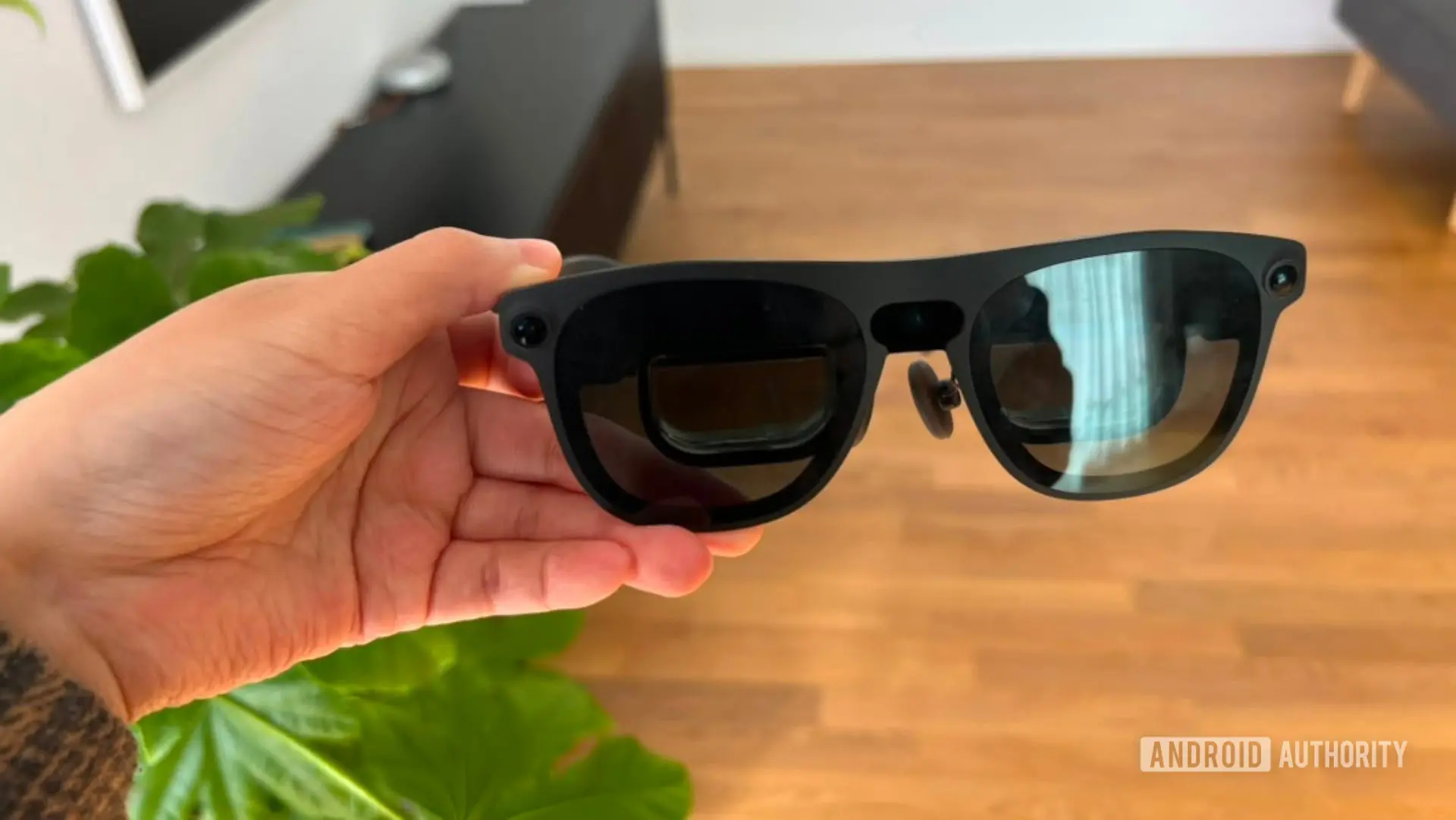
XREAL has been teasing Project Aura for a long time. For months, the company hinted at a fall launch for its first pair of Android XR glasses, and I have to admit I was skeptical. Android XR is an entirely new kind of Android experience, and early hardware in this category does not always live up to the promises. Now that I have spent some time with the Aura glasses, I find myself counting down to launch.
The company is now sharing a more concrete timeline. According to XREAL, the Aura glasses are expected to launch before the end of 2026 with a price below $1,500. That does not necessarily mean $1,499; XREAL was careful to say under $1,500 could still go lower. There is still some mystery around the final price, but the experience I had makes the price less scary than it might have been.
Android, but around you
If you have been following extended reality at all, you know that showing off the technology has never been the hard part. AR and VR companies have been making impressive demos for years. The real challenge is making the experience feel natural enough that people would actually use it daily. That is where XREAL appears to be getting surprisingly close. The easiest way to understand Android XR is to imagine Android leaving the phone and entering the space around you. Instead of looking down at a rectangular display, you might have apps, virtual screens, and digital objects floating in front of you. You could place a huge YouTube window in the air, use Google Maps as a virtual globe, or browse photos without holding a device.
Gestures that become second nature
One of the strongest first impressions came from the controls. My demo began with a quick introduction to basic hand gestures: pinch, tap, drag, and scroll. At first, I needed to think about each movement. After about ten minutes, I ended up using the gestures without constantly reminding myself what to do. That is meaningful progress for an XR device.
XREAL said the short tutorial I received is only a small piece of a larger onboarding flow. First-time users will apparently get a more detailed gesture-training sequence to help them feel comfortable with the interface. I can see why that would be helpful, but the fact that such a short demo was enough to make the controls feel intuitive is a good sign.
Familiar Android software lowers the learning curve
The deeper reason I felt at ease is that the software did not feel entirely new. Android XR is not a brand new operating system to learn. It uses apps, navigation patterns, and interactions drawn from the Android ecosystem. For anyone who has spent years using an Android phone, that creates instant familiarity. The applications launcher, multitasking concepts, and typical menu structures are built on the same mental model. That could be the biggest advantage XREAL has with general consumers, especially when trying to convince someone who has never worn an XR device before.
Hardware collaboration and specifications
Putting Android into a pair of glasses is not easy. Aura is the product of a close partnership between XREAL, Google, and Qualcomm. Google brings the Android XR software platform, Qualcomm supplies the Snapdragon Reality Elite computing platform, and XREAL contributes its experience in optics and spatial computing. XREAL also developed its own X1S Spatial Coprocessor, which may be built on TSMC process technology as well. That combination of silicon is intended to handle sensing, display, and other tasks without putting too much baggage on the glasses.
The Aura glasses include two Sony Micro OLED displays, one for each eye. Each display has a resolution of 1,920 x 1,200, and the panels can run at up to 120Hz. The field of view is 70 degrees, and XREAL uses its X Prism optical system to fit the displays into a glasses form factor.
Design will always be subjective. I did not find the Aura glasses ugly, but they are definitely a bit chunky. They may not work for everyone, especially if you prefer slim eyewear. Fortunately, XREAL has not ignored prescription lens wearers. The Aura will support prescription inserts, so users should not have to wear a second pair of glasses underneath. That kind of practical consideration matters.
Google Maps is the killer demo
For me, the most impressive use case was Google Maps. Maps on a phone is a tool you use when you need directions. Maps on XREAL Aura feels completely different. I was able to zoom in and out of cities and landmarks with a level of clarity that made the experience feel almost magical. I could spend hours just exploring locations this way.
The effect gets even better for locations that support Google's immersive experiences. At some places, a small bubble lets you enter a building and explore it as if you are standing inside. I tried this with a restaurant in New York. I could see the table layout, the entire floor plan, and the ambient lighting. It was easy to walk around different sections of the place, though I had to be careful not to bump into real objects. During more immersive moments, the glasses darkened the lenses so that I wasn't distracted by peripheral vision, but I could still glance down and see the world around my feet. That balance between virtual and physical is important for anyone who wants to use these glasses at an airport, in a hotel, or at home.
YouTube and travel potential
I also got to try watching video. There was a bug that kept the standalone YouTube app from launching, but I was still able to watch YouTube through Chrome. The virtual canvas can become enormous, essentially creating a large projector screen in front of you. That is an easy use case to understand: put on the glasses, make the screen massive, and watch a movie without relying on the tiny seat-back display during a flight.
The same logic applies at home. You could lie in bed and watch content on a screen that feels like a giant television, no physical TV needed. Battery life will determine how practical that is. XREAL did not reveal every detail about battery life, but it did say the Aura glasses should last about four to five hours for streaming. The glasses draw power from a 4,455mAh battery inside an external compute unit rather than inside the frame. The cable connecting the glasses to that compute unit is not something I can fully judge from a short demo, but I did not find it distracting during my time with the device.
Google Photos shows everyday magic
Another surprisingly compelling experience was scrolling through Google Photos. Instead of flicking through tiny thumbnails on a phone, photos appeared like a giant slideshow on an equally giant screen. That may not be the reason someone spends $1,500 on a pair of Android XR glasses, but it demonstrates the platform's potential. Many ordinary tasks we do on our phones could become more engaging when freed from a small rectangular display.
Because the Aura glasses have access to the Google Play Store, XREAL doesn't have to convince developers to start from zero. The existing Android environment gives the glasses a head start. Still, there's a big question mark around app compatibility. XREAL did not offer many details about specialized apps and launch partnerships, though it said more information is coming closer to release. Android XR will be more successful when app developers design experiences that take advantage of the spatial environment. Having the Play Store is not enough on its own.
The competitive landscape is heating up
Google is clearly committed to Android XR, and Samsung is also building its own Android XR hardware. Samsung has been working with eyewear brands like Warby Parker and Gentle Monster on non-display glasses, while Samsung Display has showcased very small RGB OLEDoS panels that might allow for experiences similar to the Aura in the future. With these pieces in motion, it is reasonable to wonder whether XREAL is waiting for Google and Samsung to make their announcements before Aura finally ships.
XREAL's approach shows what can happen when Android is combined with display technology, spatial tracking, and comfortable glasses. The core experience is strong enough that I am now eagerly watching for the official release date. Here's hoping the wait isn't much longer.
Source:Android Authority News