

Cloud Gaming's Promise vs. Nvidia GeForce Now's Reality
Cloud gaming has long been an appealing idea: play high-end games on nearly any device without buying expensive hardware. It promises freedom from upgrade cycles, access to titles across PCs, laptops, handhelds, phones, and smart TVs, and a library that follows the player rather than the machine. Nvidia GeForce Now is one of the most visible attempts to make that promise real. It lets users connect their existing Steam, Epic Games, or Xbox libraries and stream supported games from remote servers. On paper, that combination is compelling. A small monthly fee can feel like renting a capable gaming PC without the upfront cost. But the gap between the pitch and the daily experience is where GeForce Now begins to struggle. After the initial novelty fades, recurring problems with queues, latency, image quality, and game support can make the service feel less like the future of gaming and more like a promising experiment that is not ready for everyone.
What Nvidia GeForce Now Gets Right
GeForce Now deserves credit for solving one of cloud gaming's biggest historical problems: ownership. Earlier services often asked players to buy games again on a new platform. Google Stadia, for example, struggled partly because its library was tied to a storefront that many players did not want to rebuild from scratch. GeForce Now takes a different approach. It connects to libraries that players already own on Steam, Epic Games, and other storefronts. That means a user can carry over a large collection and stream supported titles without repurchasing them.
The service also offers a free ad-supported tier, which lowers the barrier to entry. Paid tiers promise better hardware, longer sessions, higher resolutions, and priority access. The Performance tier costs $9.99 per month and targets 1440p at 60 frames per second with six-hour sessions, eight-core vCPUs, 28 GB of DRAM, and access to RTX GPUs. The Ultimate tier costs $19.99 per month and targets up to 5K at 360 frames per second, eight-hour sessions, 16-core vCPUs, 56 GB of DRAM, and RTX hardware. For players who cannot afford a gaming PC or who travel often, those specs sound like a dream. When everything works, GeForce Now can deliver visually impressive results and make a thin laptop feel like a gaming machine.
The Subscription Tiers and Their Hidden Costs
The tier structure looks straightforward, but the experience does not always scale with the price. The free tier is limited to one-hour sessions, 1080p at 60 frames per second, no priority queue, and no RTX access. The Performance tier removes ads and adds priority queue, but it still comes with caveats. The Ultimate tier is positioned as the premium option, yet paying more does not guarantee instant access or flawless streaming.
| Tier | Monthly Price | Ads | Resolution and Frame Rate | Session Length | Priority Queue | CPU and DRAM | RTX Access |
|---|---|---|---|---|---|---|---|
| Free | Free | Yes | 1080p at 60 FPS | 1 hour | No | 4-core vCPUs and 16 GB DRAM | No |
| Performance | $9.99 | No | 1440p at 60 FPS | 6 hours | Yes | 8-core vCPUs and 28 GB DRAM | Yes |
| Ultimate | $19.99 | No | 5K at 360 FPS | 8 hours | Yes | 16-core vCPUs and 56 GB DRAM | Yes |
The problems begin when the service is under load. A premium tier is supposed to feel premium. Instead, subscribers can find themselves waiting in queues, watching session timers, and adjusting expectations. The price is not just the monthly fee. It is also the time lost while waiting, the frustration of a stream that drops in quality, and the feeling that the hardware on the other end is not fully under the user's control.
Queue Times Undermine the Premium Promise
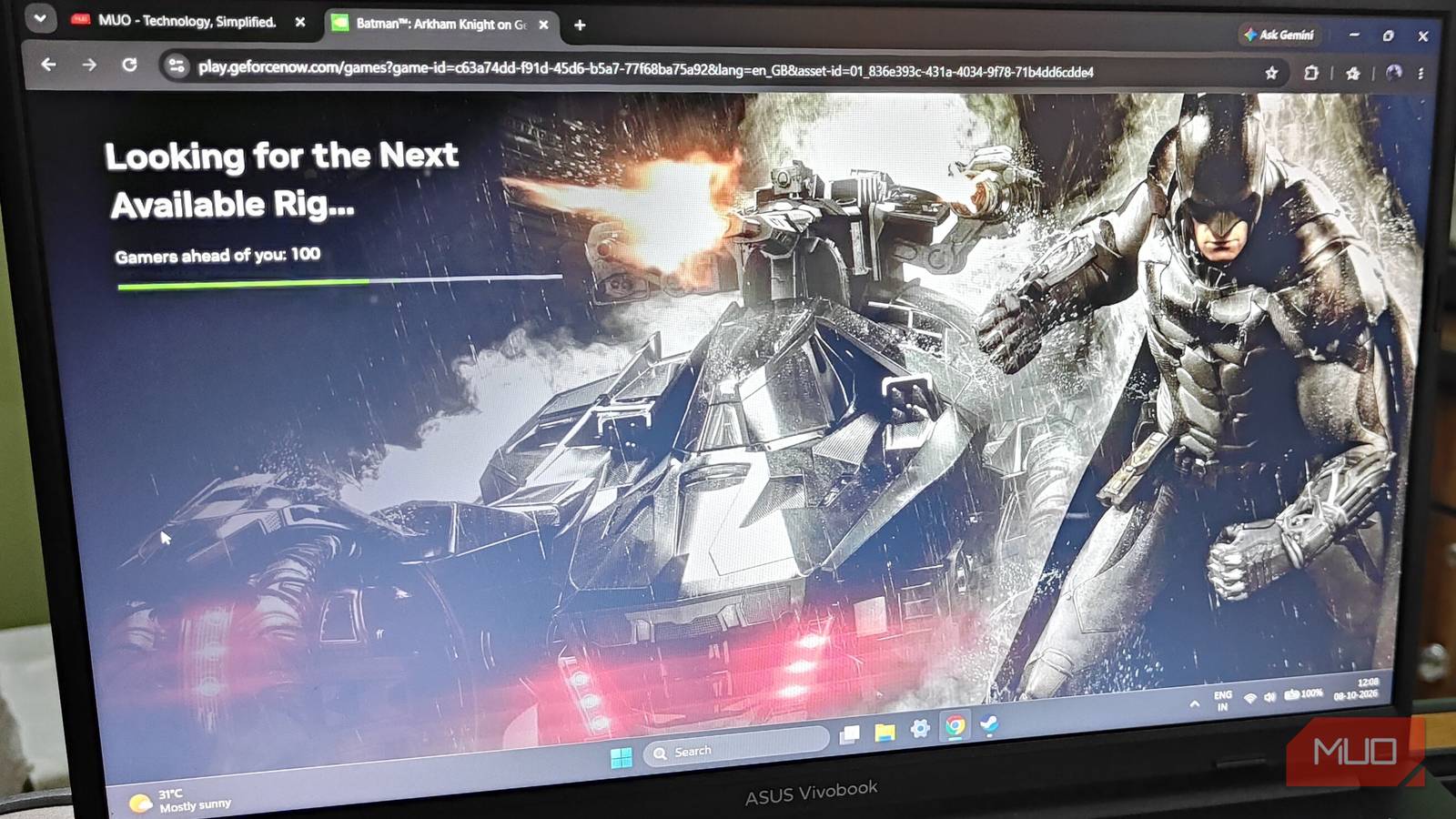
Queue times are one of the clearest examples of the gap between marketing and reality. Paid tiers advertise little to no waiting between sessions, yet lengthy queues can appear even on the Performance tier. Upgrading to Ultimate does not always solve the problem. In some cases, users have reported waiting around ten minutes or more before playing demanding titles such as The Witcher 3: Wild Hunt Remastered or Monster Hunter Wilds. Ten minutes may not sound catastrophic in isolation, but it changes the rhythm of play. A short evening session can be eaten up by waiting. A quick break becomes a test of patience. A subscription that promises convenience starts to feel like a lottery.
Cloud gaming services often face capacity crunches because they depend on data centers packed with expensive GPUs. When demand spikes, providers must balance availability against cost. That is a real operational challenge. But from the customer's perspective, the explanation matters less than the outcome. If a paid tier cannot reliably provide quick access, the value proposition weakens. The issue is not that queues exist. The issue is that they exist on plans that explicitly sell priority access as a core benefit.
Streaming Quality and Input Lag
Visual quality is another area where GeForce Now can disappoint. On Performance and Ultimate tiers, supported games can look sharp when the stream is stable. But the experience is inconsistent. Streaming quality often lands somewhere between 1080p and 1440p, which can feel soft on modern displays. Fast motion, particle effects, and detailed environments can reveal compression artifacts. A game may look impressive in a screenshot but feel less impressive in motion.
Input lag is even more important for many genres. Whether using a keyboard and mouse or a controller, some delay is often noticeable. That delay may be tolerable in slower-paced games, but it can hurt competitive shooters, fighting games, racing titles, and action games that demand precise timing. Cloud gaming's core promise is that the player will forget the game is running remotely. When input delay persists, that illusion breaks. The player is constantly reminded that every button press has to travel to a server, be processed, and travel back.
Hardware Dependence and Network Variables
GeForce Now is often described as hardware-independent. In practice, it is still hardware-dependent. The device used to stream can affect the experience. A powerful desktop on the same network may show fewer hitches and hold a steadier 1440p image, while an older laptop can suffer more frequent drops and unstable performance. That contradicts the idea that cloud gaming removes hardware barriers. The remote server may do the rendering, but the local device still has to decode the video, handle the network connection, and manage input. Wi-Fi quality, router performance, background downloads, and display resolution all matter.
This does not mean cloud gaming cannot work well. It means the experience is only as good as the weakest link between the player and the data center. For users with excellent networks and compatible devices, GeForce Now can be smooth. For everyone else, it can be unpredictable. A service that depends on so many variables will struggle to offer the same consistency as a local console or gaming PC.
The Catalog Problem: Supported Games Only
The game catalog is another limitation that is easy to underestimate. Nvidia claims support for many major releases from recent years, but the list is not universal. Games must explicitly support the service. That means some popular titles are missing. Players who want to stream FromSoftware games such as Dark Souls or Elden Ring may be out of luck. The catalog also leans heavily on free-to-play titles, many of which are already available on mobile devices. That reduces the appeal for players who want premium single-player experiences or niche titles.
There are supported games that make the service worthwhile. Lost Ark and Path of Exile, for example, can be played through GeForce Now. But the gaps are frustrating. A cloud gaming library is only as strong as the games it includes. If a user's favorite genres or franchises are not supported, the service cannot become a primary way to play. The limitation is not just technical. It is also a licensing and business issue. Publishers must agree to allow their games on the platform, and not all of them do.
Better Alternatives to GeForce Now
GeForce Now is not the only option. Several competing services offer different trade-offs, and some may be better for specific players.
| Cloud Gaming Service | Monthly Subscription Pricing | Subscription Add-on | Games Catalog | Supported Platforms |
|---|---|---|---|---|
| Xbox Cloud Gaming | $23.99 (Xbox Game Pass Ultimate or PC) | No | Xbox library and Game Pass catalog | Windows, Xbox Series X|S, Xbox One, and mobile |
| Amazon Luna | Included with Amazon Prime | Premium tier add-on for $9.99 | Small catalog with triple-A and select indie titles | Windows and mobile |
| Boosteroid | $16.89 for Ultra tier | Ultra Pro upgrade at $74.89 for six months or $134.89 for twelve months | Select triple-A titles and free-to-play games from the user's own Steam library | Windows, Linux, Tizen, WebOS, and mobile |
These services have their own caveats. Some have smaller libraries, higher prices, or add-on costs. But they also show that cloud gaming is not a one-size-fits-all market. Xbox Cloud Gaming, for instance, combines an Xbox library with the Game Pass catalog and can feel more consistent for players already inside Microsoft's ecosystem. Amazon Luna can be attractive for Prime members who want a low-friction entry point. Boosteroid supports a range of platforms and lets users stream select games from their own Steam libraries.
Cloud Gaming Is an Alternative, Not a Replacement
Cloud gaming remains an alternative rather than a replacement for traditional PC and console gaming. That is not a criticism of the technology. It is a statement about the current state of the market. For travelers, students, or players who cannot afford a dedicated gaming rig, cloud services can provide access that would otherwise be impossible. They can turn a work laptop into a temporary gaming device. They can make a hotel room feel less boring. They can offer a way to try games without downloading hundreds of gigabytes.
But they cannot yet replicate the reliability, ownership, and consistency of local hardware. A gaming PC or console does not depend on a distant server. It does not queue. It does not compress the image. It does not add input delay beyond the display and controller. There is also a psychological element. Owning the system where games run gives players a sense of control. Cloud gaming, for all its convenience, can feel like borrowing someone else's machine. That feeling matters when players invest time, money, and emotion into their libraries.
What the Future of Cloud Gaming Needs to Fix
For cloud gaming to become the future that its advocates imagine, several problems need to be solved. Capacity must improve so that paid tiers rarely face long queues. Latency must drop to the point where competitive and timing-sensitive games feel natural. Streaming quality must become more consistent, with fewer artifacts and fewer resolution drops. The catalog must expand to include more major franchises and more publisher back catalogs. Local device compatibility must become more predictable, so users are not surprised by performance differences between machines on the same network.
None of these challenges are impossible. Data centers are expanding, codecs are improving, and network infrastructure continues to evolve. But progress will be uneven. GeForce Now shows both the promise and the limits of the current generation. It can deliver moments that feel genuinely futuristic. It can also deliver waits, lag, and limitations that make players reach for a local machine. The technology is moving forward, but the experience is not yet seamless enough for every player. Until it is, cloud gaming will remain a useful companion to traditional gaming rather than the thing that replaces it.
Source:MakeUseOf News