

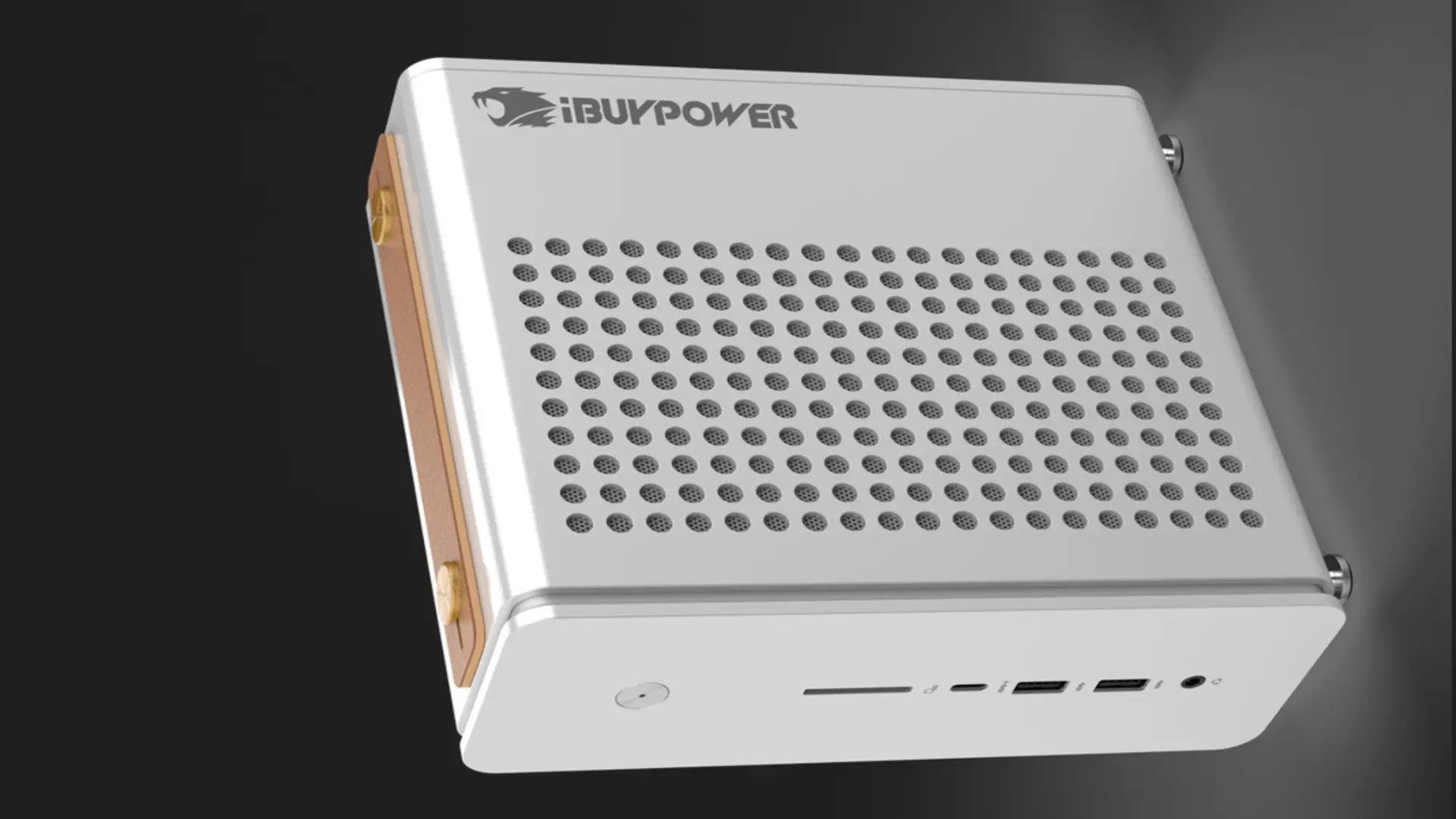
iBuyPower has entered the AI PC market with the Gorgon Halo, a $3,999 desktop that combines AMD hardware, 128GB of RAM, and a leather strap. The system is aimed at developers, researchers, and enthusiasts who want to run local AI workloads without relying on cloud services. The Gorgon Halo is not just another gaming rig with a larger memory kit; it is a statement that boutique PC builders see a future in workstation-grade AI machines.
The headline features are easy to list. The price is $3,999. The processor is an AMD platform. The memory capacity is 128GB. The case includes a leather strap for carrying. And despite the AI focus, buyers cannot cluster multiple units at launch. That last point matters because clustering is often how small AI workstations scale into larger training or inference clusters.
Key facts at a glance
- Product: iBuyPower Gorgon Halo
- Category: AI PC / desktop workstation
- Price: $3,999
- Processor: AMD Ryzen AI Max+ 395 (Strix Halo) or similar AMD high-end APU
- Memory: 128GB unified LPDDR5X RAM
- Graphics: Integrated Radeon 8060S-class GPU
- Storage: 2TB PCIe 4.0 NVMe SSD (likely configurable)
- Design: Leather strap, premium chassis, advanced cooling
- AI focus: Local inference, fine-tuning, and development
- Clustering: Not supported at launch
The Gorgon Halo appears to be built around AMD's Strix Halo platform, which is officially known as the Ryzen AI Max series. That chip family combines Zen 5 CPU cores, RDNA 3.5 graphics, and an XDNA 2 neural processing unit. The most important feature for AI work is the unified memory architecture. Instead of separate pools of RAM for the CPU and GPU, Strix Halo uses a single 128GB LPDDR5X memory pool that can be dynamically allocated. This allows the integrated GPU to access far more memory than a typical discrete graphics card. A high-end consumer GPU may have 16GB or 24GB of VRAM, which is enough for small AI models but quickly becomes a bottleneck for larger ones. With 128GB of unified memory, the Gorgon Halo can load much larger language models, including quantized versions of 70B-parameter models.
The trade-off is memory bandwidth. Strix Halo uses a 256-bit LPDDR5X interface, which delivers roughly 256 GB/s of bandwidth in the highest configurations. That is impressive for an integrated solution, but it is lower than the 1 TB/s or more offered by high-end discrete GPUs with GDDR6X or HBM. As a result, the Gorgon Halo is better suited to inference and fine-tuning than to training large models from scratch. Token generation speed will depend on the model size and quantization level. For a 70B model at 4-bit quantization, users can expect a few tokens per second, which is usable for many interactive applications but not blazing fast. Smaller models, such as 7B or 13B parameter models, should run comfortably.
The system's AI credentials are further strengthened by AMD's software ecosystem. ROCm, AMD's open compute platform, has improved significantly in recent years. Popular frameworks like PyTorch and ONNX Runtime now support ROCm, and tools like Ollama and LM Studio can take advantage of the hardware. The XDNA 2 NPU adds another layer of efficiency for low-power AI tasks, such as background noise suppression or image enhancement. However, the NPU is not a replacement for the GPU when it comes to heavy AI workloads. It is designed for always-on, low-intensity tasks.
Design is a major part of the Gorgon Halo's appeal. The leather strap is a distinctive touch that sets it apart from the typical black or white box. It suggests that iBuyPower wants the machine to be seen as a premium object, something that can sit in a design studio or executive office without looking out of place. The chassis likely features tempered glass, subtle lighting, and a clean interior layout. The strap also serves a practical purpose: a fully loaded AI workstation can be heavy, and a carrying handle makes it easier to move between desks or labs. iBuyPower has not released full dimensions or weight, but the presence of a leather strap implies a substantial build.
Cooling is another critical consideration. A 128GB unified memory system with a high-performance APU generates heat, especially under sustained AI workloads. The Gorgon Halo is expected to use a robust cooling solution, possibly a 360mm liquid cooler or a large dual-tower air cooler. The power supply is likely rated at 1000W or higher to support future upgrades and peak loads. Storage options probably start at 2TB of PCIe 4.0 NVMe, with additional M.2 slots for expansion. Connectivity may include USB4, Wi-Fi 7, and 2.5Gb Ethernet, making it easy to connect to external drives or networks.
The clustering limitation is one of the most discussed aspects of the Gorgon Halo. Clustering allows multiple computers to work together on a single AI task, pooling their memory and compute resources. This is how small workstations can be scaled into larger training clusters. For example, Nvidia's Project DIGITS and similar systems support clustering through high-speed interconnects and specialized software. The Gorgon Halo does not support clustering at launch. That means buyers cannot simply buy two or four units and expect them to function as a single larger machine. There are several reasons for this. First, AMD's Strix Halo platform does not include a high-bandwidth interconnect like NVLink. Second, the software stack for clustering consumer APUs is still immature. Third, iBuyPower may be focusing on single-node performance and stability before adding cluster support. The company has not ruled out future updates, but for now, the limitation is real.
Without clustering, the Gorgon Halo is best viewed as a powerful single-node AI workstation. It can handle local inference, fine-tuning of small to medium models, data preprocessing, and AI-assisted content creation. It is not a replacement for a data center GPU cluster. For many individual developers and small teams, however, a single node with 128GB of unified memory is a major step up from a laptop or a gaming desktop with 32GB of RAM and a 12GB GPU. The ability to run larger models locally without cloud costs or privacy concerns is valuable.
The $3,999 price point places the Gorgon Halo in a competitive but niche market. It is more expensive than a high-end gaming PC, but less expensive than many professional workstations with comparable memory. Apple's Mac Studio with M2 Ultra and 128GB of unified memory starts at a higher price, and Nvidia's Project DIGITS is expected to cost around $3,000. The Gorgon Halo differentiates itself with its AMD platform, Windows compatibility, and boutique build quality. It also comes with iBuyPower's warranty and support, which can be important for business customers.
iBuyPower is known for building custom gaming PCs, but the Gorgon Halo signals a strategic expansion into AI and professional workloads. The company is not alone. Other boutique builders are likely to follow with their own AI PCs. The market is heating up as AMD, Intel, Nvidia, Qualcomm, and Apple all push AI capabilities into personal computers. The Gorgon Halo is an early example of how system builders are responding to the demand for local AI hardware.
The name 'Gorgon Halo' is a playful nod to AMD's Strix Halo codename. A gorgon is a mythical creature, and a halo is a ring of light. The name suggests power and elegance, which matches the system's leather strap and high-end components. iBuyPower has not announced a specific release date, but the Gorgon Halo is expected to be available for order soon. Configuration options may include different storage capacities, memory speeds, and possibly a choice of operating systems. The base model is priced at $3,999.
For AI developers, the key question is whether the Gorgon Halo can run the models they need. With 128GB of unified memory, it can load large models that would not fit on a 24GB GPU. However, memory bandwidth and compute performance will limit training. Inference of 70B models is possible with quantization, and fine-tuning of smaller models is feasible. The lack of clustering means users cannot scale out easily. They can scale up by adding more memory or storage, but not by adding more nodes. That limitation may push some buyers toward Nvidia-based solutions or cloud services. For others, the convenience of a single, quiet, power-efficient desktop may be worth the trade-off.
The Gorgon Halo also highlights the growing importance of unified memory in AI PCs. As models grow larger, the amount of memory available to the accelerator becomes a critical specification. Discrete GPUs with 24GB or 48GB are no longer enough for many popular models. Unified memory architectures, whether from AMD, Apple, or Nvidia, offer a way to break through that barrier. The Gorgon Halo is one of the first boutique systems to embrace this approach. Its success will depend on software support, real-world performance, and whether customers are willing to pay $3,999 for a single-node AI workstation that cannot be clustered.
Source:TechRadar News