
Nobody wants a vehicle that succumbs to the effects of wear and tear. Between the engine, battery, transmission, pumps, gears, alternator, wiring, and countless hoses, an engine bay works as one of the most demanding environments in any machine. Heat, vibration, moisture, and chemical residue constantly work against these parts. Regular oil changes are important, but they only address one part of the system. Cleaning the engine bay is another step that can preserve performance, extend the life of components, and make it easier to spot leaks or damaged parts before they turn into costly repair jobs.
An engine bay is not a single surface. Some sections are bare metal, while others are plastic, rubber, wiring insulation, or coated electrical connections. One cleaner cannot treat all of them equally. That is why WD-40 is a useful resource for anyone who wants to care for their vehicle. Most people know WD-40 as a lubricant for squeaky hinges or a rust-prevention spray for garage tools, but the company also makes a Specialist line of products designed for deeper cleaning jobs. Below are six WD-40 products that are useful for cleaning your car's engine bay and keeping it in solid shape.
Why Engine Bay Cleaning Matters
Dirt and grease do more than make an engine bay look unpleasant. A thick layer of oil and road grime can trap heat, which is never good for sensitive parts. It can also hide small fluid leaks from the valve cover, oil pan, coolant hoses, or transmission lines. A leak that goes unnoticed can eventually cause a low fluid level that leads to serious mechanical damage. Grease can work its way into connectors and switches, causing poor electrical contact and intermittent problems. Over time, carbon deposits inside the throttle body and other intake components can disrupt airflow and reduce fuel efficiency. Regular cleaning allows you to inspect belts, hoses, clamps, and wiring while they are still easy to see.
Before using any engine bay cleaner, it is wise to let the engine cool down. Spraying cold chemicals on a hot engine can cause rapid cooling and possible damage. Cover sensitive electrical connections, fuse boxes, and open air intakes with plastic bags if you are using a strong degreaser. Avoid spraying directly into any opening on the engine or into electrical connectors. After cleaning, allow everything to dry before starting the vehicle. With those basic rules in mind, here are six WD-40 products that can handle nearly every cleaning job inside the engine bay.
WD-40 Specialist Machine & Engine Degreaser
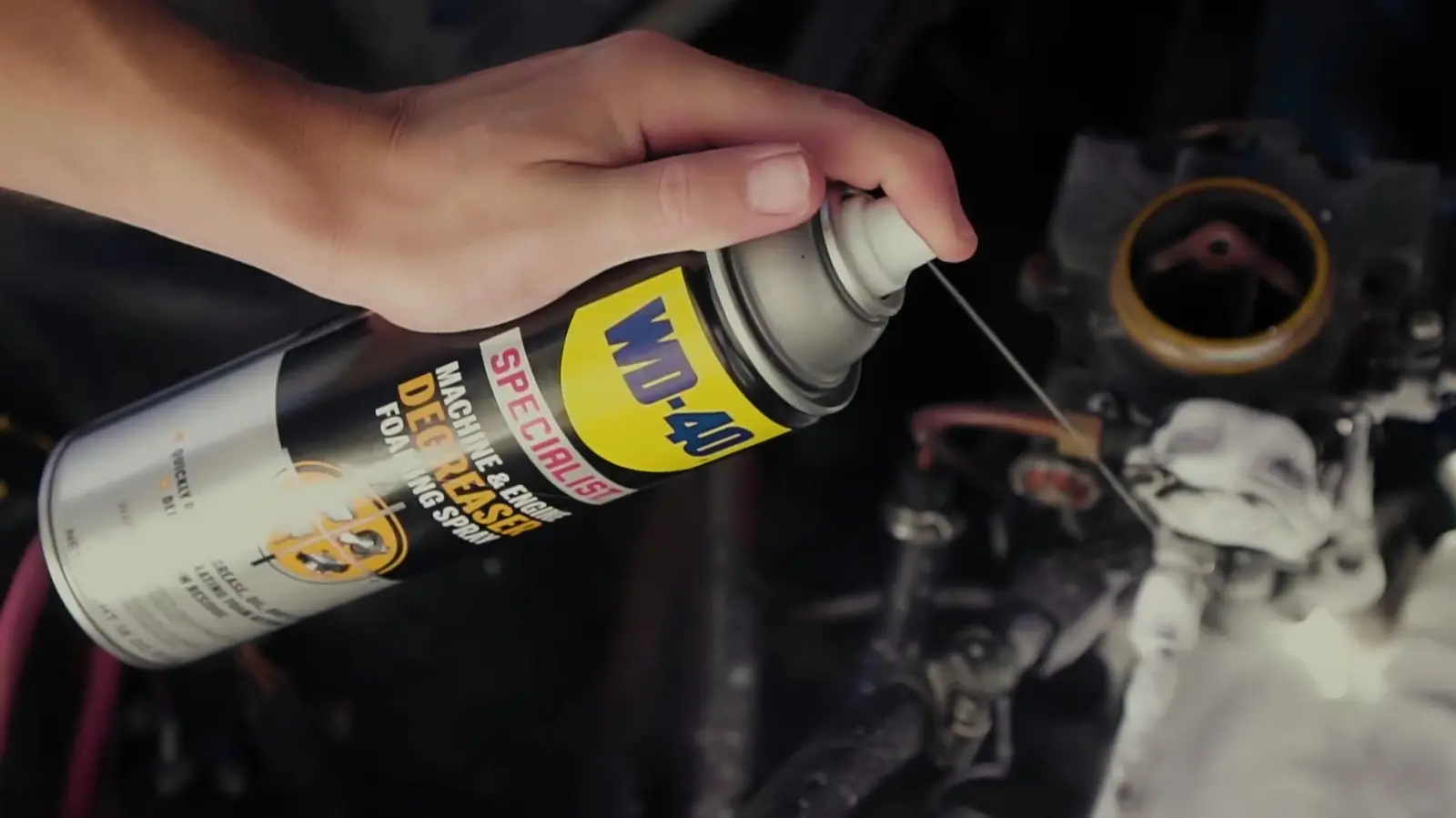
The WD-40 Specialist Machine & Engine Degreaser is the product to reach for when you want a heavy-duty method of cleaning the engine itself. This spray uses a foaming formula that clings to vertical surfaces and stays in contact with oil and grease long enough to break them down. This is important because the sides of an engine block are usually covered with baked-on oil film and road grime that ordinary wipes cannot remove.
To use this degreaser, spray the foam directly onto the areas where oil, grease, or other deposits have built up. The foam is thick enough to coat metal surfaces evenly and cut through stubborn layers of dirt. After allowing the product to work for a few minutes, rinse it away with a hose or wipe it off depending on how much residue remains. Because this is a fairly strong chemical cleaner, it is best used on metal components. Cover electrical connectors, sensors, and fuse boxes before spraying to keep moisture and cleaning chemicals away from sensitive electronics. This degreaser is especially useful for a routine under-hood cleaning session because it makes the engine block look like new and helps reveal any new leaks that might be developing.
WD-40 Specialist Degreaser
While the Machine & Engine Degreaser is designed mainly for the engine block, the engine bay contains many other parts that also collect oil, grease, and dirt. Parts like the inside of the hood, plastic covers, rubber hoses, and wiring looms need a cleaner that will not damage their surfaces. The WD-40 Specialist Degreaser is an industrial-strength spray that is safe to use on just about every kind of surface found in the engine bay, including metal, plastic, and rubber. The main thing to avoid is spraying it directly on electrical components, but with a careful application, it can take care of the rest of the compartment.
This cleaner is not a foam, so it is easier to spread across wide surfaces. Spray it on a rubber hose, plastic shroud, or painted inner fender, and then wipe the area with a towel. The heavy-duty formula is tough on buildup but does not require heavy scrubbing. Once it is wiped away, the surface is left clean and ready for inspection. Even though the product is called industrial-strength, it can be washed off your hands with soap and water. For engine bay owners who want a broad cleaner for all of the non-engine areas, this product is an excellent option.
WD-40 Specialist Carb/Throttle Body Cleaner
Grease and oil are not the only contaminants that affect an engine bay. Carbon buildup is one of the most damaging issues an engine can face. Carbon deposits can form on throttle bodies, carburetors, and other intake surfaces. This can restrict airflow, change the air-fuel mixture, and eventually cause poor idling, hesitation, increased fuel consumption, or even component failure. Removing carbon requires a cleaner that can dissolve the baked-on deposits that ordinary degreasers might leave behind.
WD-40 makes the Specialist Carb/Throttle Body Cleaner specifically for this task. It comes as an aerosol spray with a dual-action design. First, solvents soften and loosen the carbon deposits. Then a forced blast of air pushes the residue away from the damaged surfaces. This is useful whether you are cleaning an assembled throttle body or a part that has been removed from the vehicle. The fast-acting formula can also be used on carburetor parts and other fuel-system components. For anyone who wants to dig into a thorough engine bay cleaning, this is the product that addresses the hidden layer of contamination that many sprays miss.
WD-40 Specialist Electrical Contact Cleaner
Your engine bay is full of electrical components. The battery, wiring connections, ignition coils, fuse panels, and various sensors all need to be free of oil, dirt, and corrosion to work properly. Moisture and road grime can slowly attack these connections and cause frustrating electrical problems. WD-40 Specialist Electrical Contact Cleaner is designed to remove those contaminants without leaving behind the kind of residue that can attract more dirt.
This spray is safe to use on plastic, rubber, and metal surfaces, so you do not need to worry if a spray drifts onto an adjacent component. It evaporates quickly and can be wiped off with a towel or left to air dry if the part has been removed from the vehicle. The cleaner is especially helpful for the battery terminals and cable ends, where corrosion can build up and reduce the flow of electrical current. Spraying the contacts and wiping them clean can help maintain a reliable starting system and prevent many hard-to-diagnose electrical issues. It is a smart addition to any engine bay cleaning routine.
WD-40 Specialist Degreaser and Cleaner EZ-Pods
Not every car owner wants to store a large collection of spray bottles in their garage. Some people prefer one flexible cleaner that handles multiple jobs around the house and garage. WD-40 Specialist Degreaser and Cleaner EZ-Pods offer the convenience of an all-purpose cleaner without requiring another bulky spray bottle. The pods are small dissolvable capsules that create a ready-to-use cleaner when mixed with water.
To use a pod, fill a 32-ounce spray bottle with water and drop in the pod. Once the pod dissolves, you have an effective cleaner that can be sprayed onto metal, concrete, rubber, plastic, and other common surfaces. In the engine bay, it can wipe away light oil, dirt, and grime from a variety of parts. It is not as heavy-duty as the concentrated degreasers made specifically for severe buildup, but it is a convenient option for a quick clean-up or for people who want to use the same product on garage tools and household items. As with other engine bay cleaners, it is still a good idea to avoid spraying it directly onto sensitive electronics.
WD-40 Precision Pen
Many engine bay cleaning jobs require covering large surfaces, but some jobs demand extreme accuracy. Aerosol sprays can reach narrow spaces if you use the small straw attachment, but even the narrowest spray can overshoot the target. WD-40 Precision Pen provides a different solution: it puts WD-40's original formula into a pen-style applicator that lets you place the lubricant or cleaner exactly where you want it.
The fine tip is ideal for cleaning and lubricating small linkages, latches, hinges, fasteners, and other tight spots in the engine bay. It is also a useful tool for preventing rust and corrosion on small bare-metal surfaces. Spot treatments can be applied without wasting product or saturating surrounding parts. The pen is compact enough to fit in a pocket, so it can be kept inside the vehicle or moved between work areas. Being able to apply that kind of protection precisely helps extend the longevity of components that are easy to overlook during a normal wash.
Together, these six WD-40 products cover a full range of engine bay cleaning needs: heavy grease removal from the engine, multi-surface cleanup for hoses and covers, carbon breakdown for throttle bodies, electrical contact maintenance, convenient all-purpose degreasing with EZ-Pods, and precise lubrication and rust prevention with the Precision Pen. Keeping all of them in your garage gives you the right tool for every type of contamination and makes it much easier to care for the parts under your hood.
Source:SlashGear News