

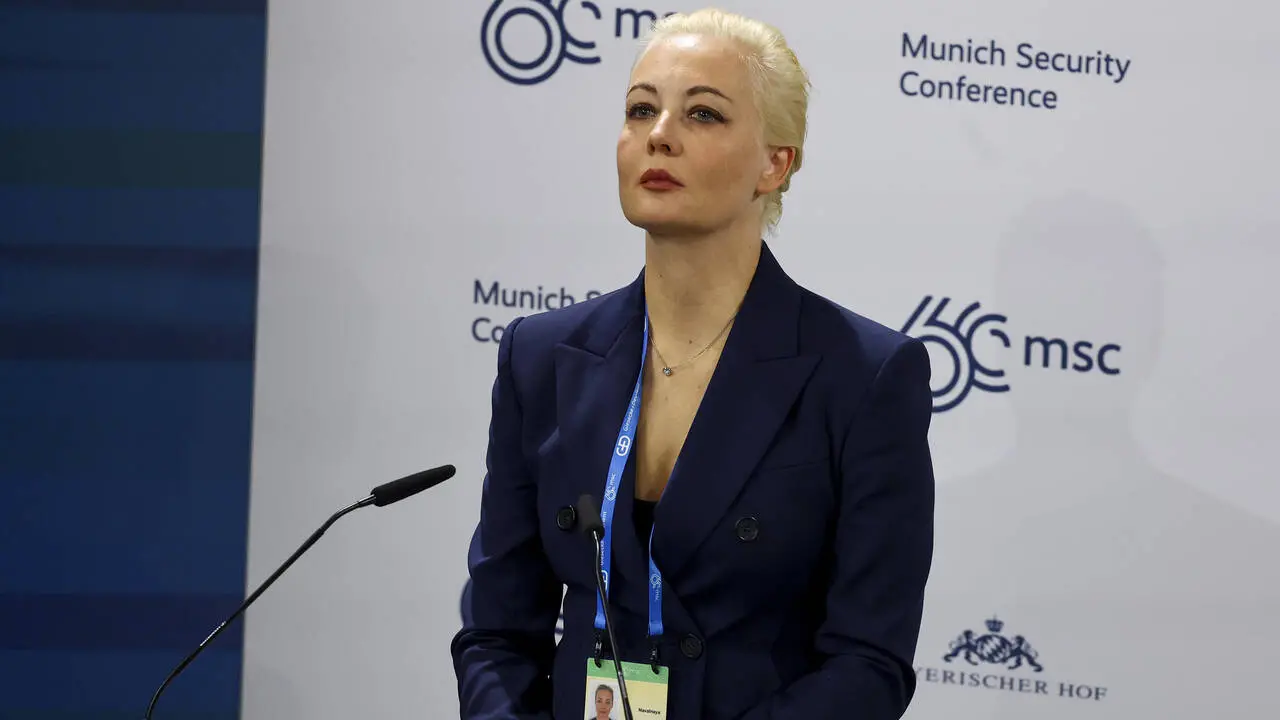
On February 16, 2024, Russian media announced that Alexei Navalny, the country's most prominent opposition leader, had died in prison. The news sent shockwaves through the international community, and nowhere was the emotion more palpable than at the Munich Security Conference, where his wife, Yulia Navalnaya, appeared before a stunned audience.
She stepped to the podium amid thunderous applause. Standing straight, her face drawn, she addressed the hall in Russian: “You have all heard the terrible news. I asked myself whether I should be here before you or return to my children. I thought about what Alexei would have done. And I am sure he would have told me to come on stage.” In the opulent Bayerischer Hof ballroom, where the 60th Munich Security Conference was opening, the atmosphere was charged with grief and defiance.
It was a moment that underscored the personal tragedy behind the political struggle. Yulia Navalnaya has long been a steadfast presence alongside her husband, enduring his poisonings, arrests, and years of imprisonment. But this time, she was alone, facing the world as a widow whose husband’s life was cut short by a regime he had spent decades challenging.
A Life of Opposition
Alexei Navalny rose to prominence in the late 2000s through his anti-corruption investigations, which exposed high-level graft among Russian officials. His blog and YouTube channel, with millions of followers, made him a household name. He staged mass protests in 2011 and 2012 against Vladimir Putin’s return to the presidency, and later ran an ambitious presidential campaign in 2018, despite being barred from the ballot.
Navalny’s methods were modern and relentless. His team produced investigative films, organized regional strikes, and built a grassroots network that threatened the Kremlin’s monopoly on power. His 2017 documentary about Prime Minister Dmitry Medvedev’s alleged wealth sparked nationwide demonstrations. In 2020, he was nearly killed by a Novichok nerve agent and spent months recovering in Germany. He returned to Russia in January 2021, knowing he would be arrested immediately. He was sentenced to long terms on what his supporters and Western governments called fabricated charges.
The Munich Address
At the Munich Security Conference, Yulia Navalnaya did not just mourn her husband; she delivered a message of resolve. She noted that the news of Alexei’s death had not yet been confirmed, but she declared that if it were true, she would continue his work. “I do not know what exactly happened,” she said, while making clear that responsibility rested with Vladimir Putin. “If Alexei was killed, then this is the highest level of corruption in Russia.”
The conference, an annual gathering of world leaders, diplomats, and security experts, had been dominated by discussions about the wars in Ukraine and Gaza. But Navalnaya’s appearance shifted the center of gravity. Moments before she spoke, US Vice President Kamala Harris had taken the stage. Addressing the news, she said that if it were confirmed, it would be “another sign of Vladimir Putin’s brutality.” The audience rose to its feet, applauding Yulia Navalnaya for several minutes.
Global Reaction
World leaders reacted with outrage to Navalny’s reported death. US President Joe Biden blamed Putin and warned of consequences. European Union foreign ministers demanded a transparent international investigation. German Chancellor Olaf Scholz called it a “terrible turn of events.” In London, the British government summoned the Russian ambassador. The NATO secretary general, Jens Stoltenberg, said the news was a reminder of the price of dissent in Russia.
In Russia, news of Navalny’s death was met with a wave of arrests as citizens attempted to lay flowers at memorials. Authorities tried to disperse small gatherings in several cities, but the public response reflected deep frustration among the opposition's supporters. Many of Navalny’s allies, living in exile, vowed to carry on his mission. “They can kill Alexei, but they cannot kill his ideas,” said a statement from his team.
A Legacy of Courage
Yulia Navalnaya’s appearance in Munich was also a reminder of the personal cost borne by families of political dissidents. She and Alexei met in the 1990s, and she stood by him through every ordeal. After his first imprisonment, she became a social media presence in her own right, at times reading legal briefs and visiting him in prison. When he was poisoned, she learned to navigate international medical institutions and kept the public informed. Together, they raised two children, who now face a future without their father.
As she left the podium, the applause did not stop. In the halls of the Bayerischer Hof, delegates gathered in hushed groups, trying to process the significance of the moment. Some drew parallels to the assassinations of other Kremlin critics, such as Anna Politkovskaya and Boris Nemtsov. Others noted that Navalny’s death could further galvanize Western support for Ukraine, which shares a common adversary in Putin.
The Broader Context
The Munich Security Conference has long been a forum for transatlantic dialogue. This year’s meeting was meant to address a rapidly changing security landscape, from the Russia-Ukraine war to instability in the Middle East. But the news from Russia cast a long shadow. For many delegates, Navalny’s death was a stark reminder that authoritarianism is not a distant concept but a lived reality for millions of Russians.
Yulia Navalnaya’s words echoed beyond the conference hall. “I am not sure I am as brave as Alexei,” she said. “But I will do everything I can to continue our common cause.” Her quiet determination became a symbol of resistance against the Kremlin. Whether she will formally step into a political role remains uncertain, but her presence on that stage signaled a determination not to be silenced.
The coming days are likely to bring more details about the circumstances of Alexei Navalny’s death. His team has called for an independent investigation, saying that prison officials cannot be trusted to provide an accurate account. The Russian prison service claimed he died after a walk, but such statements have been met with skepticism from his allies and international observers.
History has shown that repressive regimes often believe they can erase their critics by eliminating them. But the memory of those who fight for freedom tends to outlast their persecutors. Alexei Navalny will be remembered not for the circumstances of his death, but for the courage he displayed in life. And on that stage in Munich, Yulia Navalnaya made it clear that the fight is not over.
Source:Letemps News