

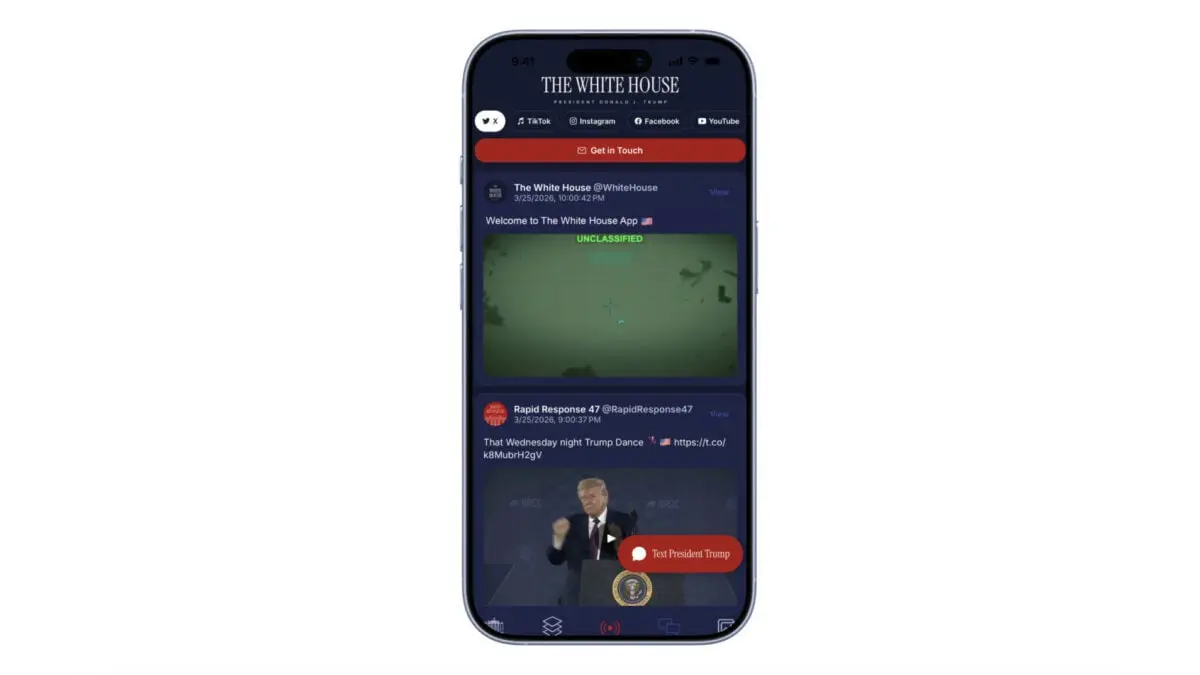
Background: The White House App Mandate
In a move that echoes the infamous 2014 automatic installation of U2’s album “Songs of Innocence” onto iPhones, the Trump administration is reportedly pushing the White House app onto all mobile devices used by the Department of Homeland Security (DHS). According to an internal email obtained by Politico, DHS employees were notified Tuesday that the app—originally released in March—will be auto-loaded onto their work phones. The email describes the application as “a convenient way to access official White House communications, including announcements, executive actions, speeches, livestreams, videos and other updates.”
The app, available on both Apple’s App Store and Google Play, was launched with much fanfare earlier this year. The White House’s own press release boasts that it provides “unfiltered, real-time updates straight from the source,” with the source being President Donald Trump himself. Among the listed features are breaking news alerts, video streaming, a library of archived Trump sound bites, the ability to “stay connected” with new policies, and an option to send feedback—including via voice. A screenshot on the White House website even shows a post with the text “That Wednesday night Trump dance🕺🇺🇸,” which the administration used as an illustration of the app’s interface.
Data Sharing and Privacy Concerns
However, beneath the benign promise of keeping users informed, there are troubling privacy and security implications. According to a report by Notus.org, the White House app collects and shares user data—including time zone, IP address, device identifiers, and more—with third parties. Notably, Notus states that the app “doesn’t disclose its data sharing the way most others do,” raising questions about compliance with standard privacy practices and federal data protection guidelines.
This is not the first time a White House official app has existed. In 2010, during the Obama administration, a similar app was released. However, that earlier version was far less intrusive; it was purely informational and did not come pre-installed on government devices. The current iteration, by contrast, is being forced onto the phones of federal employees who have little choice in the matter. Last month, Government Executive reported that the Trump administration had instructed federal agencies to begin installing the app on employee phones, starting with the Federal Aviation Administration (FAA). The FAA was already slated to receive the app as an auto-download, setting a precedent for other agencies to follow.
Security Experts Sound the Alarm
The forced installation has drawn sharp criticism from cybersecurity experts and former government IT officials. Sonny Hashmi, a former IT executive with the General Services Administration, told Government Executive that auto-installing the app is “cause for alarm.” He warned, “Any app that is installed on government issued devices can potentially create backdoor access to government networks behind the firewall.” Hashmi’s concern underscores a fundamental risk: by adding an app with unknown or opaque data-sharing practices to a device that may access sensitive government databases, the administration could be inadvertently exposing critical infrastructure to surveillance, data leaks, or even espionage.
Given that DHS is responsible for homeland security, border control, cybersecurity, and disaster response, the prospect of a third-party app with unrestricted data access is alarming. The app’s ability to send audio feedback also introduces the possibility of recording conversations or capturing ambient audio without explicit consent, further compounding privacy risks. While the White House claims the app is merely a communication tool, the lack of transparency about its data handling procedures has left many experts unconvinced.
Historical Parallels: The U2 Incident and Beyond
The comparison to Apple’s 2014 U2 album auto-download is apt—but with darker undertones. In that case, millions of users were irked by an uninvited album appearing in their music libraries; here, the stakes are infinitely higher because the device is owned by the government and used for official business. The U2 incident was primarily a nuisance and a privacy breach only if users didn’t want that music. The White House app situation involves potential surveillance, data monetization, and a conflict of interest when the government mandates an app that may harvest employee data for the benefit of political operatives.
Moreover, the email seen by Politico suggests that employees who have not yet downloaded the app will have it forced upon them. This leaves little room for opt-out or consent, raising questions about the legality of such an action under federal privacy laws and the Privacy Act of 1974. The Office of Management and Budget (OMB) has yet to issue a public statement on whether this practice aligns with existing guidelines for federal employee device management.
Broader Implications for Federal Device Policy
This development comes at a time when the federal government is increasingly concerned about mobile security. The Department of Defense, for example, has strict policies regarding the use of personal apps on work devices, often requiring approval from security officials. If the White House can bypass such protocols for its own app, it sets a dangerous precedent that could be exploited by future administrations or even malicious actors who infiltrate the app’s supply chain.
Privacy advocates have called for an immediate halt to the auto-installation until a full security audit is conducted. The Electronic Frontier Foundation (EFF) and other watchdog groups are expected to file public records requests to uncover the app’s data-sharing agreements. In the meantime, DHS employees have been left with little recourse; refusing to use the app could be seen as insubordination, and uninstalling it—if that is even possible—might raise red flags.
The White House has not responded to requests for comment on the security concerns, but sources familiar with the matter suggest that the administration views the app as a vital tool for ensuring that all federal employees are aligned with the president’s messaging. This rationale, however, overlooks the fundamental purpose of government-issued devices: to serve the public interest, not to serve as a platform for political spin.
As the rollout expands to other agencies, the debate over the app’s true intentions is likely to intensify. What began as a simple communication app may well become a flashpoint in the larger battle over digital privacy, government overreach, and the boundaries of executive power in the workplace.
Source:Gizmodo News