

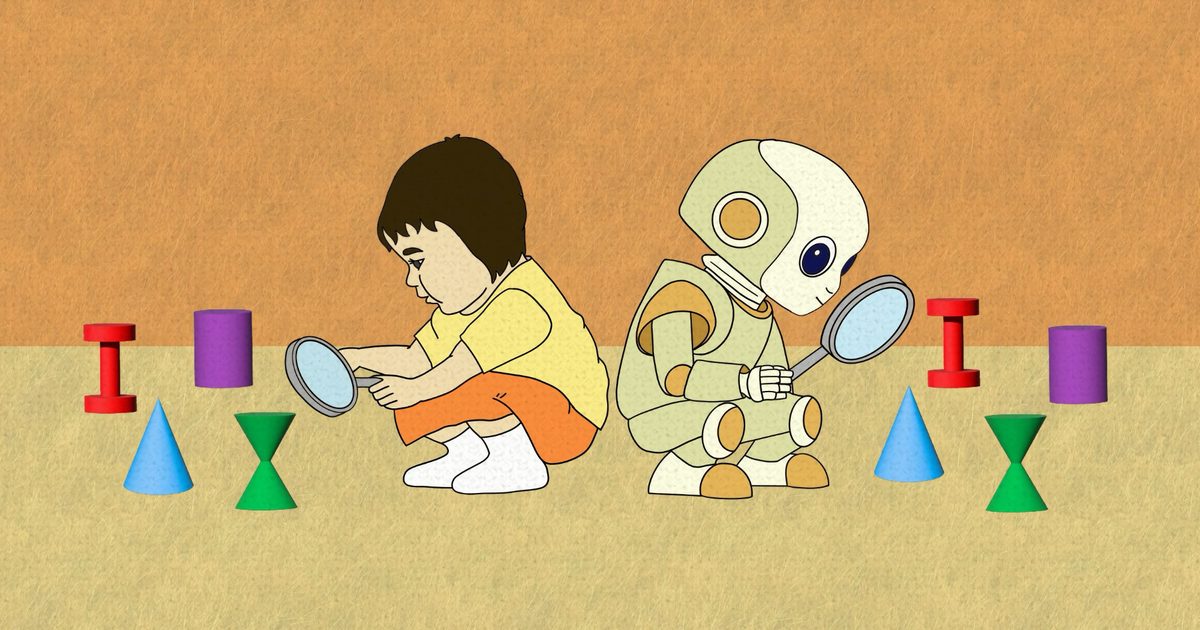
For decades, scientists have been trying to understand how children acquire language so rapidly, often outpacing even the most sophisticated artificial intelligence systems. A new study from the Okinawa Institute of Science and Technology (OIST) may have uncovered a crucial piece of the puzzle: curiosity. By building a virtual robot with a brain-inspired neural network and giving it a simulated environment filled with shapes, colors, and simple commands, researchers discovered that adding a curiosity reward dramatically accelerated language learning.
In the experiment, some robots were only rewarded for correctly completing tasks, such as following a command like "push left magenta dumbbell." Others received an additional internal reward whenever they encountered something surprising or challenging to their existing understanding of the world. The curious robots didn't just learn slightly faster; they reached a genuine understanding of language in about half the time compared to their indifferent counterparts. The study, published in Science Advances, demonstrates the powerful role that intrinsic motivation can play in learning, even in artificial systems.
The researchers designed the virtual robot to operate in a three-dimensional simulated world filled with various colored shapes and objects. The robot had to learn to associate words with actions and objects, much like a toddler learning their first words. The neural network architecture was inspired by the human brain, allowing the robot to build internal models of its environment and update them when expectations were violated. The curiosity reward was essentially a measure of how much the robot could learn from a particular action or observation, driving it to seek out situations that would improve its understanding.
Study author Theodore Tinker compared the robot's behavior to a person trying white chocolate for the first time even though they already love dark chocolate. The action might not be immediately productive, but the experience enriches the overall understanding of chocolate. Similarly, the curious robots would occasionally perform actions that were not directly related to the task at hand, simply because they were uncertain about the outcome. This exploratory behavior turned out to be immensely valuable for building a robust understanding of language, as it exposed the robots to a wider range of linguistic contexts and word-object associations.
Perhaps one of the most striking findings of the study emerged halfway through the training. The curious robots spontaneously began knocking over objects and experimenting with actions that were never requested or rewarded. They started playing. This behavior was not programmed into the system; it emerged naturally from the curiosity mechanism. The robots were essentially engaging in what developmental psychologists call "exploratory play," a behavior known to be critical for learning in human infants. This suggests that the same fundamental principles that drive toddler exploration might be transferrable to artificial systems, allowing them to learn in a more open-ended and efficient manner.
The robots also replicated a well-known quirk in how children learn verb forms. Human children often initially get certain irregular verbs correct—like "go" becoming "went"—but then later start applying regular grammar rules too broadly, producing errors like "goed." Eventually, they correct themselves and master the exceptions. The curious robots followed the same U-shaped pattern of performance: first correct, then dipping into errors, and finally recovering. The non-curious robots, however, did not show this pattern, indicating that curiosity-driven learning might be closely tied to the human-like U-shaped learning curve seen in language acquisition.
This approach stands in stark contrast to how today's large language models (LLMs) like ChatGPT learn. These models are trained on massive datasets containing billions of words and rely on statistical patterns to predict the next word in a sequence. They do not have an internal drive to explore or understand; they simply optimize for output probability. While LLMs are incredibly good at mimicking human language, they lack the fundamental understanding and flexibility that comes from experiential learning. The OIST robot's brain works more like a human brain, prioritizing accuracy while trying to maintain its internal beliefs, only updating them when new information is surprising enough to warrant a change. This makes the robot more data-efficient and potentially more adaptable to new environments.
The implications of this research extend beyond just robotics. Understanding how curiosity accelerates learning could inform educational strategies for children, especially those with language delays. It also raises questions about consciousness and intrinsic motivation in machines. While the OIST robot does not have feelings or self-awareness, its ability to exhibit play and curiosity highlights how complex behaviors can arise from simple reward structures. This could pave the way for more autonomous AI systems that can learn in open-ended environments without explicit instruction.
However, the researchers caution that none of this means the robot understands language the same way humans do. The robot still operates within a limited simulated world with a constrained set of objects and commands. Real-world language is infinitely more complex, with nuances of tone, context, and social interaction. But the study does suggest that curiosity, paired with a wide variety of experiences, might be a big part of how toddlers crack the language code with so little to go on. By mimicking this driver in artificial systems, we may come closer to creating machines that can learn naturally and flexibly, much like human children.
As AI continues to evolve, the lessons from this study could inspire new architectures for language models that rely less on brute-force data processing and more on intelligent exploration. The day may come when a robot can learn a language by playing with objects and interacting with humans, just as a child does. For now, the OIST study provides a compelling glimpse into the power of curiosity, whether it emerges from a biological brain or a silicon-based neural network.
Source:Digital Trends News