

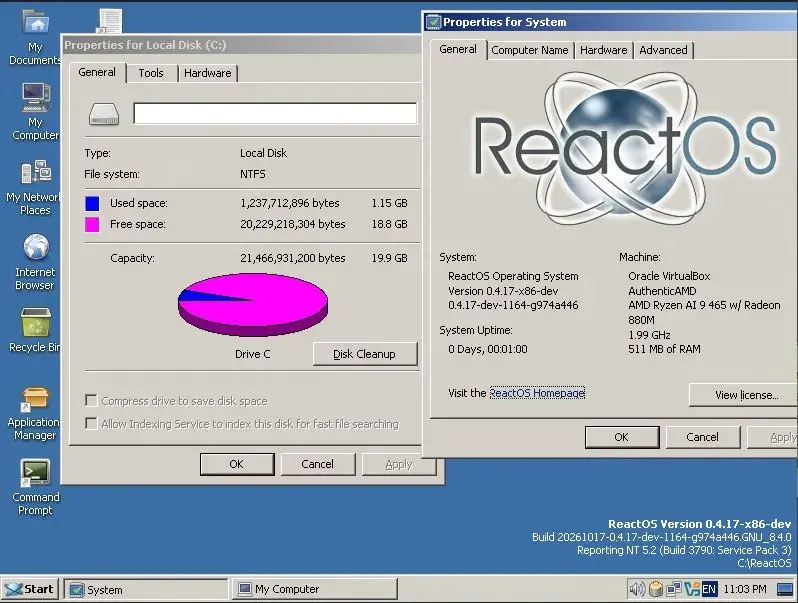
A Major Hurdle Cleared
ReactOS has reached a milestone that developers and testers have awaited for years: the open source Windows alternative can now be installed directly onto an NTFS drive partition. The change removes a long-standing restriction that forced users to maintain a FAT32 partition for installations. For a project that aims to reproduce the Windows environment, the shift is more than a technical convenience. It closes a practical gap that had separated ReactOS from the filesystem used by most modern Windows systems.
Before the update, ReactOS installations depended on FAT32. That requirement was workable for testing and development, but it created friction. FAT32 has limits that are increasingly irrelevant on modern hardware but still matter for an operating system trying to mirror Windows behavior. Users who wanted to run ReactOS alongside existing Windows installations often had to carve out a separate partition, manage boot entries, and accept that the ReactOS side of the system would not live on the same filesystem as the Windows side.
Why NTFS Support Matters
NTFS is a proprietary filesystem developed by Microsoft. Its roots trace back through the Windows NT family, beginning with Windows NT 3.1 in 1993. The variant introduced with Windows XP in 2001 remains the standard used by most Windows systems today. That history matters because ReactOS has set its sights on binary compatibility with Windows Server 2003. If the project is trying to recreate a Windows-compatible environment, being confined to FAT32 partitions was a practical barrier that needed to be cleared.
Filesystem support is not a cosmetic feature. An operating system's filesystem driver sits close to the kernel and handles the creation, reading, writing, and deletion of files and directories. It must also manage metadata, permissions, and consistency in the event of a crash. For ReactOS, adding NTFS installation support means the installer can write the operating system onto a partition formatted with the same filesystem that mainstream Windows uses. That moves the project closer to its stated goal of reproducing the Windows environment rather than asking users to work around it.
The milestone also matters for testing. Developers and adventurous users can now evaluate ReactOS in configurations that more closely resemble real Windows deployments. Instead of treating FAT32 as a special case, the project can begin exercising NTFS code paths during installation and normal operation. That exposure is likely to produce bug reports, compatibility findings, and performance data that would be harder to gather in a FAT32-only world.
What the New Driver Can and Cannot Do
The announcement comes with important caveats. ReactOS has warned that the new driver still lacks caching, which causes inferior performance. It also lacks journaling and security support. Those omissions are significant. Caching helps an operating system avoid repeated disk reads and writes, and its absence can make file operations feel sluggish. Journaling helps a filesystem recover from crashes and power loss by recording pending changes before they are committed. Security support is central to NTFS permissions and access control. Without those pieces, the driver is a major step forward but not a finished implementation.
The project has also cautioned that there are potentially undiscovered bugs. That warning should be taken seriously. A filesystem driver has the power to corrupt data if it mishandles writes, metadata, or recovery paths. Users who want to try ReactOS on an NTFS partition should treat the installation as experimental. Backing up important data is essential, and anyone testing the driver should avoid using a disk that contains irreplaceable files. The milestone is impressive, but it does not turn ReactOS into a production-ready replacement for Windows overnight.
Nearly a Decade in the Making
The new driver closes a gap in development that stretches back nearly a decade. Read-only NTFS support was added to ReactOS in 2016. That allowed the operating system to read files from an NTFS partition, but it did not provide the full write support needed for installation. In 2022, boot support landed on FreeLoader. That meant the bootloader could read from an NTFS partition, but the operating system itself still could not be directly installed there. The latest change connects those pieces: installation can now proceed on an NTFS partition rather than being limited to FAT32.
The timeline illustrates why filesystem work is often slower than outsiders expect. Read-only support is a useful first step because it lets developers inspect and test NTFS structures without risking writes. Boot support is another layer because the bootloader has to find and load the kernel from the filesystem. Full installation support requires reliable write paths, directory creation, file allocation, metadata updates, and enough stability to place an entire operating system on disk. Each stage builds on the previous one, and each stage can expose new bugs.
A Community Project With a Difficult Mission
ReactOS is a community-developed open source project that describes itself as mostly driven by volunteers. Development is coordinated through public channels, and contributors can learn how to participate through the project's website. That volunteer-driven structure is part of what makes the NTFS milestone notable. Reimplementing an operating system from scratch is an enormous undertaking. It requires work on the kernel, drivers, subsystems, libraries, build tools, testing infrastructure, and compatibility layers. It also requires patience, because progress is often measured in small compatibility fixes rather than dramatic releases.
The project has remained in alpha for a long time, and its decades-long timeline underscores the scope and difficulty of recreating Windows-compatible behavior without using Microsoft's source code. NTFS is one of the most complicated pieces of that puzzle. The filesystem includes features such as journaling, security descriptors, compression, sparse files, and caching. A clean-room implementation must reproduce enough of that behavior to work with real disks while avoiding legal and technical pitfalls. The new driver does not solve all of those problems, but it gives ReactOS a working path for installation on the filesystem that matters most to Windows users.
What Changes for Testers
For testers, the immediate change is practical. ReactOS can now be installed on an NTFS partition, so users no longer need to keep a separate FAT32 partition solely for ReactOS. That simplifies some dual-boot and testing setups, and it allows the operating system to share the same filesystem type as the Windows installation on a machine. The change may also make it easier to compare behavior between ReactOS and Windows on similar storage configurations.
Those benefits come with limits. The lack of caching affects performance, the lack of journaling affects crash recovery, and the lack of security support affects permissions. Anyone testing the new driver should expect rough edges. The smart approach is to use a dedicated test machine, a spare disk, or a virtual machine with snapshots. Data that matters should be backed up elsewhere. The project's warning about undiscovered bugs is not boilerplate; it is a realistic assessment of a new filesystem driver in an alpha-stage operating system.
The Road to Beta
The milestone brings ReactOS one step closer to finally reaching beta, but it does not mean beta is imminent. A beta would require broader stability, more complete driver support, and enough compatibility to satisfy testers and developers. The NTFS driver still needs work on caching, journaling, security, and bug fixing. Installation support is a gateway feature: it lets more people try the operating system in more realistic configurations, which in turn generates the feedback needed to improve it.
ReactOS may never become a truly viable alternative to Windows for most users. The project's ambitions are unusual, and the competition is a moving target. Even so, this step forward means that at least now ReactOS can be installed on the same filesystem as the real thing. For a project built by volunteers and sustained over decades, that is a meaningful achievement. It turns a long-standing barrier into a development path, and it gives the ReactOS community a new baseline for testing, fixing, and extending the operating system.
Source:Ars Technica News