

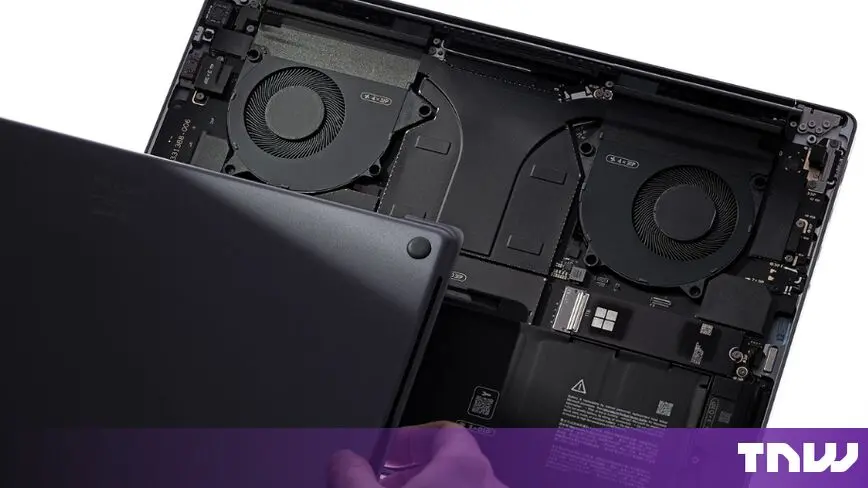
Microsoft has priced its first Nvidia-powered Surface laptop at $2,599.99 and opened pre-orders, setting up a direct challenge to Apple's MacBook Pro. The Surface Laptop Ultra, as the company calls it, is built around Nvidia's RTX Spark platform, which pairs a Blackwell graphics processor with an Arm-based Grace CPU. Microsoft says the machine returns prompts from locally run AI models twice as fast as Apple's MacBook Pro M5 and generates video six times quicker. It has not published a test methodology for either claim.
Key facts at a glance
- Price: $2,599.99
- Pre-orders: open now
- Processor: up to 20 Nvidia Grace cores
- Graphics and AI: Nvidia Blackwell GPU, up to one petaflop of AI compute claimed
- Memory: up to 128GB unified memory
- Storage: up to 2TB, upgradeable
- Display: peak brightness of 2,000 nits measured over a 10% window with HDR content
- Claimed performance: 2x MacBook Pro M5 on local AI prompts, 6x faster video generation
- Competitive price: undercuts a 16-inch MacBook Pro by roughly $400
- Repairability: published repair guides, replacement parts and upgradeable storage
What Microsoft announced
Executives made the comparison on stage in San Francisco on Wednesday. The product page lists the price, processor options, memory and storage. The only measurement Microsoft footnotes is the screen's peak brightness: 2,000 nits, measured over a 10% window with HDR content, against laptops available in October 2026. The Apple numbers get no equivalent footnote.
The omission matters because performance claims are central to the pitch. Microsoft is asking buyers to pay a premium price for a new class of Windows laptop. The claim that it doubles a MacBook Pro M5 on local AI prompts is specific, but without methodology it is not independently verifiable. The same is true of the claim that video generation is six times quicker.
Microsoft's product page carries the price, a processor of up to 20 Nvidia Grace cores, up to 128GB of unified memory and up to 2TB of storage. The company also says the laptop has published repair guides, replacement parts and upgradeable storage. That combination is unusual for a flagship Surface device. In the past, Surface laptops have been criticized for sealed designs, expensive repairs and limited upgrade options. If Microsoft delivers on repairability, it could differentiate the Surface Laptop Ultra from Apple's MacBook Pro, which also has limited internal upgradeability.
The chip: Nvidia's RTX Spark and Arm's architecture
The most consequential part of the announcement is the silicon. RTX Spark pairs a Blackwell graphics processor with Nvidia's Grace CPU, co-designed with MediaTek. Nvidia claims up to one petaflop of AI compute. Dell, HP, Lenovo, Asus and MSI are shipping machines built on it. That puts Nvidia into a laptop market Intel and AMD have shared for decades.
It gets there on someone else's instruction set. Grace is built on Arm's architecture, licensed from the Cambridge company Nvidia agreed to buy for $40 billion and could not, after regulators objected and SoftBank confirmed the deal dead in February 2022. Every RTX Spark laptop now pays Arm a royalty instead. The arrangement is a reminder that Nvidia's push into PCs depends on an architecture it tried to own and failed to acquire.
The failed acquisition also shaped the competitive landscape. Arm's instruction set is the foundation for Apple's M-series chips, Qualcomm's Snapdragon X processors and a growing number of data center CPUs. Nvidia's Grace CPU adds another major customer for Arm while intensifying competition with Intel and AMD. For Microsoft, supporting Arm-based Windows laptops is a long-term bet. The company has worked to improve Windows on Arm for years, but app compatibility and performance have often lagged behind x86 machines. A high-end Nvidia chip could change that calculation if developers optimize for it.
For Microsoft, the move is also a strategic bet. The company has spent years trying to make Windows a credible platform for local AI, rather than a shell for cloud services. Running models on the device can reduce latency, avoid sending sensitive data to remote servers and lower cloud compute bills. But it also requires powerful hardware, large amounts of memory and software that can take advantage of both. The Surface Laptop Ultra is the clearest test yet of whether that combination can command a premium price.
Price and positioning
At $2,599.99, the Surface Laptop Ultra undercuts a 16-inch MacBook Pro by roughly $400. That is a deliberate positioning choice. Apple's high-end laptops are the benchmark for premium portable performance, especially among creative professionals and developers. Microsoft wants buyers to see its Nvidia-powered machine as a faster, cheaper alternative.
The price is also notable because component costs have been rising. A memory shortage has pushed hardware prices up, and Nvidia raised its DGX Spark by about 75%, to $6,950. At $2,599.99, the Surface looks less expensive by comparison, but it is still far above the average laptop. The question is whether the AI performance claims are strong enough to justify the premium for buyers who may not yet need local AI acceleration.
Analysts have long identified cost as the open question for AI PCs. The first generation of AI laptops arrived with modest performance gains and unclear use cases. Many buyers saw them as ordinary laptops with a new marketing label. A machine that can run larger models locally at high speed could be different, but only if the software ecosystem supports it. Microsoft has promoted Copilot and other AI features across Windows, yet much of the heavy lifting still happens in the cloud.
Repair, upgrades and the hardware details
Microsoft says the Surface Laptop Ultra has published repair guides, replacement parts and upgradeable storage. That is a meaningful shift for a company whose Surface devices have often been criticized for being difficult to repair. If Microsoft follows through, the laptop could appeal to businesses and power users who keep machines for years and want to avoid replacing a whole unit when storage fills up.
The device supports up to 128GB of unified memory and up to 2TB of storage. Unified memory is important for local AI workloads because large models need to fit in memory to run efficiently. The processor tops out at 20 Nvidia Grace cores. Nvidia's claimed one petaflop of AI compute is a headline figure, but real-world performance will depend on software optimization, thermal design and battery life.
Battery life is especially uncertain. High-performance AI workloads can drain a laptop quickly, and a 2,000-nit display also consumes power. Microsoft has not published runtime estimates for local AI tasks. The MacBook Pro M5 is known for strong battery life under mixed workloads, so matching or beating it while running demanding models would be a significant engineering achievement. Buyers will want independent tests, not just stage comparisons.
The market: falling shipments and cautious buyers
The buyers are the problem. European laptop shipments are forecast to fall 6.4% this quarter and 20% in the fourth, with desktops down almost 30%, as memory costs raise system prices and companies stretch their refresh cycles. Gartner does not expect AI PCs to be a majority of shipments until 2028.
That forecast creates a difficult backdrop for any premium laptop launch. Businesses are not rushing to replace working machines. Consumers are dealing with higher prices for components and are more likely to wait for discounts. Even if AI PCs are the future, the market is not yet behaving as if that future has arrived. Microsoft is launching a high-priced, high-performance machine into a cautious spending environment.
The AI PC category has also suffered from unclear benefits. Many so-called AI PCs run small models locally for tasks like transcription, image editing and chat. But cloud-based AI tools are often more capable and can run on cheaper hardware. Microsoft's pitch is that running AI on the machine in front of you is cheaper and more secure than paying a cloud provider. That argument may become stronger as model efficiency improves and privacy rules tighten.
There is also competition from within. Nvidia's RTX Spark will appear in laptops from Dell, HP, Lenovo, Asus and MSI. Microsoft's Surface may be the flagship, but it will not be the only option. PC makers can undercut Microsoft on price or offer different designs, including gaming laptops and mobile workstations. Nvidia benefits regardless of which brand sells, while Microsoft needs the Surface Laptop Ultra to stand out in a crowded field.
Security and sovereignty: the Dutch tax office example
Microsoft's pitch has an unusual audience. Its executives argued that running AI on the machine in front of you is cheaper and more secure than paying a cloud provider. The Dutch tax office reached that conclusion about its email this week, and is moving it off Microsoft's cloud onto its own servers.
That example cuts both ways. It shows that even large organizations are reconsidering dependence on cloud providers. It also shows that Microsoft is not only competing with Apple and PC makers; it is competing with its own cloud business. If customers decide to run more workloads locally, Microsoft may sell more Windows laptops and fewer cloud subscriptions. If they decide to move off Microsoft's cloud entirely, the company loses either way.
The debate over digital sovereignty has grown in Europe, where regulators and public agencies have raised concerns about data stored by U.S. technology companies. Local AI hardware could address some of those concerns by keeping data on the device. But it also creates new challenges, including device management, security updates and the cost of replacing fleets of laptops. The Dutch tax office's decision to move email off a major cloud provider is a signal that some buyers are willing to pay for control.
What to watch next
Several questions remain unanswered. Microsoft has not released independent benchmarks for its AI performance claims. It has not detailed battery life under sustained local AI workloads. It has not said how much the upgradeable storage and memory configurations will cost. It has not explained how developers will optimize for the RTX Spark platform across Windows and Nvidia's software stack.
The first reviews will matter. If the Surface Laptop Ultra can run local models quickly and reliably, it could establish Nvidia as a serious laptop chip competitor and give Microsoft a premium machine that stands apart from standard Windows laptops. If the AI claims do not hold up in independent testing, the price will be harder to justify, especially in a market where shipments are falling and buyers are stretching refresh cycles.
For now, the headline is clear: Microsoft has priced its first Nvidia-powered Surface at $2,599.99 and claimed performance that beats Apple's MacBook Pro M5 on local AI tasks. The chip inside is built on Arm's architecture, from the Cambridge company Nvidia failed to buy in 2022. The buyers, the benchmarks and the battery life will determine whether the claim becomes a real competitive threat or a stage number that does not survive contact with the market.