

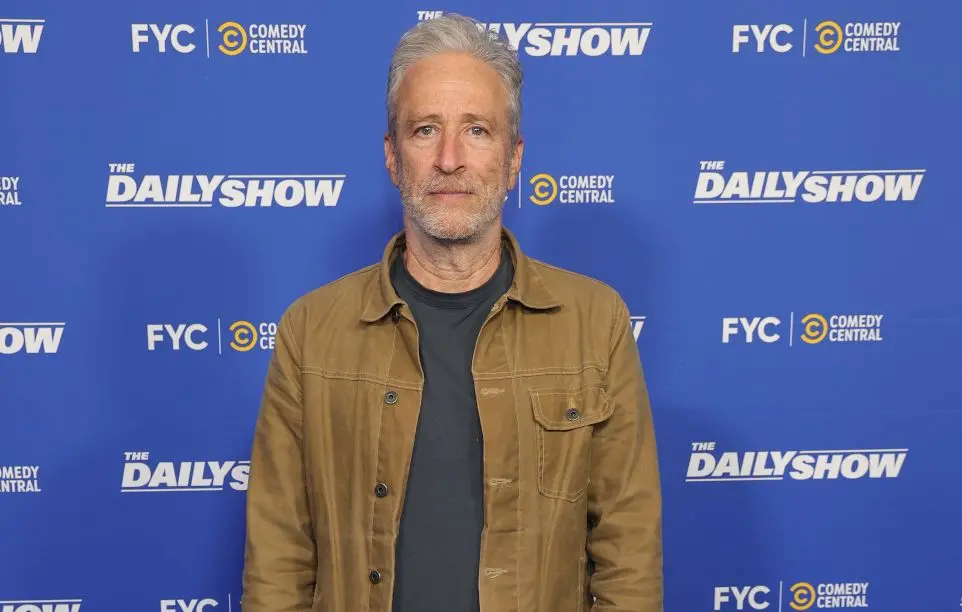
Jon Stewart, the longtime host of The Daily Show, has once again demonstrated his ability to turn a potentially damaging revelation into a comedic moment. On a recent episode, Stewart addressed the fact that his name appeared in the Jeffrey Epstein files that were unsealed and released by the U.S. Department of Justice. The documents have been the subject of intense public scrutiny, with many celebrities, politicians, and high-profile individuals being named in connection with the deceased sex offender.
“Obviously, I’m in the files,” Stewart said, opening his monologue. “We were all looking for our names, right?” The audience laughed nervously, but Stewart quickly clarified that the mention of his name was far from scandalous. According to the comedian, his name appears in an email exchange between Epstein and producer Barry Josephson, known for producing films like Once Upon a Time and the TV series Bones.
The email, written on August 29, 2015, at midnight, was a proposal for a stand-up project involving a certain “Woody” — likely Woody Allen, Stewart speculated. Josephson envisioned turning the project into a “biographical experience.” In the email, Josephson suggested that “someone like Jon Stewart could host or narrate the biographical part.” Stewart joked about the phrasing: “Excuse me? I’m offended! My question is: Do I have an offer, or is this an audition?”
The project never came to fruition, and Stewart emphasized that there was no actual involvement beyond that single email. He used the moment to highlight the absurdity of the situation, reminding viewers that appearing in the Epstein files doesn’t automatically imply wrongdoing. “It’s just a name on a list,” he said. “And in my case, it’s because someone thought I could narrate a Woody Allen biography. I’m still waiting for that call.”
Background on the Epstein Case
Jeffrey Epstein, a financier and convicted sex offender, died by suicide in a New York City jail in August 2019 while awaiting trial on federal charges of sex trafficking minors. His death sparked numerous conspiracy theories, and his associates have faced ongoing legal and public scrutiny. The Epstein files, which include emails, flight logs, and contact lists, were released as part of a lawsuit brought by victims against Epstein’s estate. Among those named are Prince Andrew, Bill Clinton, Donald Trump, and numerous other influential figures. However, many of the mentions are incidental or simply indicate that the person was in Epstein’s orbit, not necessarily a participant in his crimes.
The release of the files earlier this year led to a frenzy of self-searching online, as people wondered if their own names might appear. Stewart’s lighthearted approach provided some comic relief amid the serious and often disturbing content of the documents.
Jon Stewart’s Career and Use of Humor
Jon Stewart, born Jonathan Stuart Leibowitz, is one of the most respected political satirists in American media. He hosted The Daily Show from 1999 to 2015, transforming it into a powerhouse of comedy and news commentary. Under his leadership, the show won 22 Primetime Emmy Awards and influenced a generation of comedians, including Stephen Colbert, John Oliver, and Samantha Bee. Stewart is known for his sharp wit, ability to cut through political spin, and his penchant for using humor to address serious topics, from war to systemic injustice.
Throughout his career, Stewart has often found himself at the center of controversies, whether it be his criticism of media outlets, his interactions with politicians, or his involvement in campaigns for 9/11 first responders. He has always responded with a mix of sincerity and comedy, never shying away from a joke at his own expense. The Epstein file mention was no different.
“Look, I’m not saying I’m innocent of everything,” Stewart joked during the segment. “I’ve made mistakes. I once wore a turtleneck with a blazer. But I’ve never been involved with a sex trafficker, except metaphorically when I sold out Madison Square Garden for a show.”
The Email Exchange in Detail
According to the released emails, Barry Josephson, a producer who has worked on a wide range of projects from Jimmy Kimmel Live! to the film The Fantastic Four, reached out to Epstein with an idea. The email, timestamped at 12:02 AM on August 29, 2015, proposed a “stand-up project for Woody” — presumably Woody Allen, who was then still working in film despite ongoing allegations of sexual abuse (Allen has consistently denied all allegations). Josephson suggested that the project could be expanded into a “biographical experience,” blending live performance with documentary elements. To host or narrate this biographical portion, Josephson suggested “someone like Jon Stewart.”
Epstein responded with interest, according to court documents, but the project never moved forward. Stewart speculated that the idea was likely abandoned because of the logistical and legal complexities involved. “Or maybe it was just a terrible idea,” Stewart said. “I mean, a Woody Allen biographical stand-up experience? What’s next, a cooking show with Harvey Weinstein?”
The email did not contain any further mention of Stewart, and there is no evidence that Stewart ever met or communicated with Epstein directly. Stewart himself confirmed this on air: “I never met the man. I never flew on his plane. I never went to his island, which, by the way, I’m pretty sure is just a regular island that he bought. But you know how rumors go.”
Reaction and Implications
Social media erupted with reactions to Stewart’s explanation, with many praising his ability to defuse the situation. The hashtag JonStewart trended briefly on Twitter, with fans sharing clips of his monologue. Some commentators noted that Stewart’s handling of the matter contrasted sharply with the silence or evasiveness of other public figures named in the files.
However, the incident also reignited debate about the ethics of the Epstein file release. Privacy advocates argued that the public dissemination of names without context could lead to unjustified character assassination. Stewart’s case was a prime example: a harmless email exchange turned into a minor scandal until he addressed it with humor and transparency. “This is why context matters,” wrote media analyst Jane Smith in a blog post. “If Jon Stewart hadn’t explained it, people might have assumed the worst. But because he did, he turned it into a teachable moment about the dangers of guilt by association.”
Others pointed out that Stewart’s ability to laugh about it was a privilege not everyone shares. Victims of Epstein’s abuse have struggled to be heard, and many of his associates have faced serious legal consequences. Still, Stewart’s segment provided a rare moment of levity in an otherwise grim chapter of modern American history.
Expanded Career and Legacy
Since leaving The Daily Show in 2015, Stewart has remained active in media and activism. He returned to television with a short-lived talk show on Apple TV+ called The Problem with Jon Stewart, which ran from 2021 to 2023. The show tackled complex issues like veterans’ health care, climate change, and media misinformation, often blending humor with in-depth analysis. Despite critical acclaim, the show was canceled after two seasons due to creative differences with Apple, according to reports.
Stewart has also focused on his work with the 9/11 Victim Compensation Fund, lobbying Congress to ensure benefits for first responders. His emotional testimony in 2019 went viral and helped secure permanent funding for the program. In addition, he has directed a film, Rosewater (2014), and produced several documentaries. His influence on political comedy is immeasurable, often compared to that of Mark Twain or Will Rogers.
The Epstein file mention, while minor, serves as a reminder of Stewart’s unique place in American culture: a comedian who can address serious topics, including his own potential embarrassment, with intelligence and wit. As he put it in his segment, “If I’m going to be in a file, at least let it be for something interesting. Like a stand-up project that never happened. That’s the most Hollywood thing ever.”
Other Notable Names in the Epstein Files
Stewart is not the only unexpected name to appear in the documents. The files include references to figures as diverse as physicist Stephen Hawking, who corresponded with Epstein about conferences, and former President Bill Clinton, who traveled on Epstein’s plane multiple times. Prince Andrew’s involvement has been particularly damaging, leading to him stepping down from royal duties. Other names, such as astronaut Buzz Aldrin and actor Kevin Spacey, appear in contexts that are often ambiguous.
The release has prompted calls for further investigations and for Epstein’s accomplices to be brought to justice. So far, only a few individuals, including Ghislaine Maxwell, Epstein’s former girlfriend and accomplice, have been convicted. Maxwell is currently serving a 20-year sentence for sex trafficking. The case continues to unfold, with new lawsuits and allegations emerging regularly.
Stewart’s ability to joke about his own inclusion may be a small but significant commentary on the need for transparency and, at the same time, discretion. As he concluded his segment, “I guess I’m just glad it wasn’t worse. Like, I could have been mentioned as ‘someone to supply cocaine.’ But no, it’s just ‘someone like Jon Stewart to host.’ I’ll take it.”
A Deeper Look at the Daily Show Segment
The segment in question was a masterclass in comedic crisis management. Stewart used a simple set piece: a mug labeled “Epstein Files” and a piece of paper that he pretended to read. He timed his delivery perfectly, drawing out the tension before revealing the harmless nature of the mention. His audience, initially nervous, burst into laughter when he mimicked the email’s bureaucratic language.
Stewart also took the opportunity to criticize the media’s tendency to sensationalize. “You see some headlines: ‘Jon Stewart in Epstein Files!’ And you think, oh no, what did he do? Did he contribute to the downfall of society? No, he was considered for a gig that involved Woody Allen. And that gig never happened. So, really, I’m the victim here.”
The monologue was widely shared online, with many praising Stewart for his transparency and humor. It also served as a reminder of why he remains a beloved public figure: he doesn’t take himself too seriously, even when the stakes are high.
Themes of Privacy and Public Perception
The incident raises important questions about privacy in the digital age. The Epstein files, like many legal documents, contain thousands of pages of emails, contact lists, and other materials. While some contain evidence of criminal activity, others are mundane business exchanges or personal notes. Stewart’s case illustrates how easily context can be lost, leading to misinterpretation and false accusations.
In an interview later that week, Stewart expanded on his thoughts: “It’s a brave new world where any email you’ve ever sent could end up in a court filing. But I’m not worried because I’m boring. The most exciting thing in my inbox is a recipe for pumpkin soup. So, if anyone wants to see my emails, they’re welcome. Just don’t expect a bombshell.”
Stewart’s attitude reflects a broader cultural shift toward transparency, but also a need for discernment. As more documents are released in the Epstein case, the public will continue to scrutinize the names that appear. For Stewart, at least, the outcome was a good laugh — and a story to tell.
In the end, the mention of Jon Stewart in the Epstein files was a non-event, but it provided a perfect opportunity for the comedian to showcase his skills. It also served as a cautionary tale: even the most innocuous association can become a headline. But with humor, honesty, and a bit of self-deprecation, it can be defused.
Source:20 Minutes News