

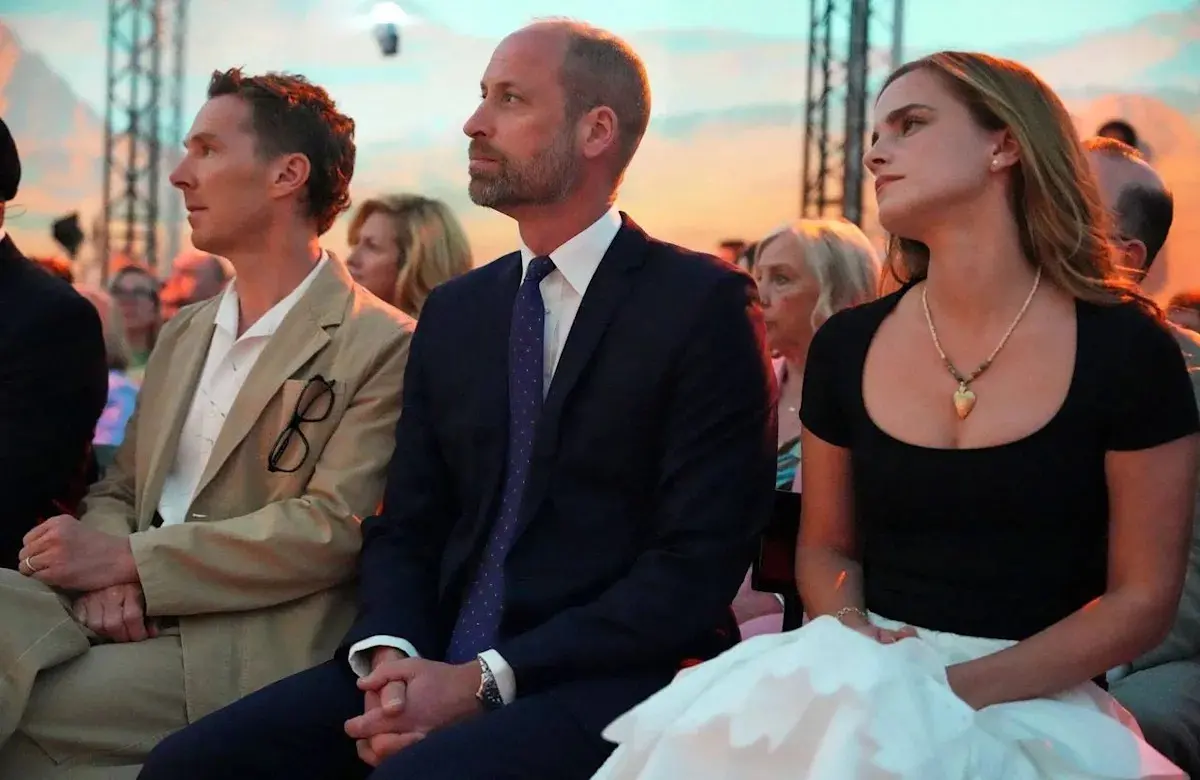
On June 22, Prince William stepped into the spotlight at a London forum for his organization United for Wildlife, drawing widespread attention as he was joined on stage by two of Britain’s most celebrated actors: Emma Watson and Benedict Cumberbatch. The event, held in conjunction with Climate Action Week, brought together leaders from business, government, and the arts to address the escalating crisis of environmental crime and illegal wildlife trade. Photographs captured the trio in animated discussion, their presence underscoring the urgency of a cause that has become increasingly central to the prince’s public work.
Prince William founded United for Wildlife in 2013 under the auspices of the Royal Foundation, the philanthropic vehicle he shares with Catherine, Princess of Wales. The initiative was born out of a stark recognition that wildlife crime—poaching, trafficking of endangered species, and the destruction of ecosystems—represents not only a conservation disaster but also a driver of conflict, corruption, and destabilization in some of the world’s most vulnerable regions. Over the past decade, United for Wildlife has grown into a coalition that includes governments, law enforcement agencies, non-governmental organizations, indigenous communities, and private sector actors. Its flagship program, the Financial Taskforce, works with banks and financial institutions to disrupt the money flows that fund wildlife trafficking, while its transport sector partnerships aim to tighten supply chains and detect illegal shipments.
The forum in London served as a platform for sharing progress and challenges. Prince William delivered opening remarks that emphasized the interconnectedness of climate change and biodiversity loss. He noted that the illegal wildlife trade is not only an ecological issue but also a threat to global security and public health, as it often facilitates the spread of zoonotic diseases. The prince’s speech was followed by a panel discussion in which he was joined by Watson and Cumberbatch, both of whom have long records of activism in environmental and social causes.
Emma Watson, best known for her role as Hermione Granger in the Harry Potter film series, has been a vocal advocate for gender equality, sustainable fashion, and LGBTQ+ rights. In recent years, she has focused increasingly on environmental issues, working with organizations such as the UN Women Goodwill Ambassador program and the sustainable fashion movement. At the forum, Watson spoke about the need for collective action and the power of storytelling to shift public attitudes. She highlighted the importance of consumer choices in driving change, urging attendees to support companies that commit to ethical and sustainable practices. Her involvement with United for Wildlife reflects her broader belief that the fight against environmental crime intersects with social justice.
Benedict Cumberbatch, an actor renowned for his roles in Sherlock, The Imitation Game, and Doctor Strange, has also been an outspoken conservationist. He has supported a range of environmental charities, including the World Wildlife Fund and the Rainforest Foundation, and has used his platform to campaign against wildlife crime. At the forum, Cumberbatch discussed the role of the creative industries in raising awareness and influencing policy. He emphasized that the arts can make abstract threats like biodiversity loss tangible and emotionally resonant, which can motivate audiences to take action. His participation lent star power to the event and underscored the growing involvement of celebrities in conservation diplomacy.
The forum took place amid a broader context of increasing international attention on wildlife trafficking. The United Nations has recognized that illegal trade in wildlife is worth billions of dollars annually, threatening thousands of species with extinction and undermining the rule of law in many countries. United for Wildlife has been at the forefront of efforts to scale up global responses, including by facilitating cooperation between law enforcement agencies across borders. The organization has also supported field initiatives such as training for rangers in Africa and Scotland, and capacity-building for indigenous patrols in South America.
Prince William’s personal commitment to the cause has been evident in his travels and public appearances. He has visited conservation projects in Africa, Asia, and the Americas, often highlighting the work of local communities who serve as the first line of defense against poaching. The prince has also spoken about the need to address the demand side of the illegal wildlife trade, particularly in consumer countries in Asia and the Middle East where products like ivory, rhino horn, and pangolin scales are in high demand. United for Wildlife’s campaigns have targeted these markets through education and advocacy, aiming to reduce consumption and shift norms.
The London forum was not a static event but part of a series of engagements leading up to the United Nations Climate Change Conference later in the year. Prince William has increasingly positioned environmental issues as a core pillar of his public role, alongside mental health, early childhood, and homelessness. The Royal Foundation has launched initiatives such as the Earthshot Prize, which awards £1 million each to five innovative solutions to environmental challenges annually. The prize has drawn support from global figures, including Sir David Attenborough, and has helped catalyze investment in areas such as renewable energy, nature restoration, and circular economy.
The presence of Watson and Cumberbatch also signaled a broader trend of celebrities lending their voices to conservation. While some critics argue that celebrity activism can be superficial, research suggests that high-profile endorsements can significantly boost public awareness and engagement. The trio’s appearance generated extensive media coverage, bringing United for Wildlife’s message to audiences far beyond the usual environmental spheres. The event was covered by major news outlets and featured on social media platforms, where images of the prince laughing with the actors were widely shared.
In addition to the star-studded panel, the forum included presentations from experts in wildlife crime, finance, and technology. Panelists discussed innovations in tracking wildlife smuggling, such as DNA analysis of seized ivory to pinpoint geographic origins, and the use of blockchain to certify legal and sustainable supply chains. Representatives from the banking sector talked about the challenges of identifying suspicious transactions among millions of routine financial flows, and how machine learning can help flag potential wildlife traffickers. The private sector has become an increasingly important partner, as companies recognize that environmental crime poses risks to their operations and reputations.
Another key theme of the forum was the role of indigenous peoples and local communities in conservation. Speakers highlighted that some of the most effective anti-poaching efforts are community-led, where local residents gain legal rights to manage wildlife and receive benefits from tourism or sustainable harvests. These models have proven successful in countries like Namibia, where community conservancies have helped restore populations of elephants and black rhinos. However, such initiatives require long-term support and investment, and many communities face threats from armed poachers and corrupt officials.
The United for Wildlife forum also provided an opportunity for the prince to announce new partnerships and funding commitments. A statement released after the event confirmed that several major corporations had pledged to strengthen their supply chain transparency and to support training for law enforcement agencies in key transit countries. The foundation also unveiled a new digital tool that will allow customs officials to share real-time intelligence on suspected wildlife shipments. These practical steps are part of a broader strategy to move from awareness-raising to measurable impact.
While the focus of the event was on wildlife crime, the broader context of climate change was never far from discussions. Prince William has often linked the two issues, noting that the same activities that drive deforestation and habitat loss—such as illegal logging and land conversion—also contribute to carbon emissions and biodiversity collapse. The Royal Foundation’s approach emphasizes that conservation and climate action are mutually reinforcing: protecting intact forests and wetlands not only safeguards species but also stores vast amounts of carbon, helping to mitigate global warming.
For Emma Watson and Benedict Cumberbatch, the forum was an opportunity to deepen their involvement in a cause that aligns with their personal values. Watson has used her platform to promote sustainable fashion and has been a longtime supporter of People Tree and other ethical brands. Cumberbatch, meanwhile, has narrated documentaries about wildlife trafficking and has participated in campaigns to ban the trade in elephant ivory. Their presence alongside Prince William was a powerful visual statement that the fight against environmental crime transcends partisan lines and appeals to a wide cross-section of society.
As the event drew to a close, participants left with a sense of both urgency and optimism. The challenges are vast: an estimated one million species are at risk of extinction, many of them due to human activities and wildlife crime. Yet the coalition that United for Wildlife has built demonstrates that there is a growing recognition of the problem and a willingness to act across sectors. The prince’s leadership, combined with the star power of Watson and Cumberbatch, has helped keep the spotlight on an issue that can sometimes be overshadowed by other global crises.
The forum in London was just one moment in a long-term campaign, but it exemplified the kind of cross-sector collaboration that will be essential if the world is to reverse the tide of biodiversity loss. With renewed commitments and innovative tools, United for Wildlife continues to push forward, aiming to make wildlife trafficking as socially unacceptable as slavery or child labor. Prince William, Emma Watson, and Benedict Cumberbatch together sent a clear message: the time for action is now, and everyone has a role to play in protecting the planet’s precious wildlife for future generations.
Source:Fr News