

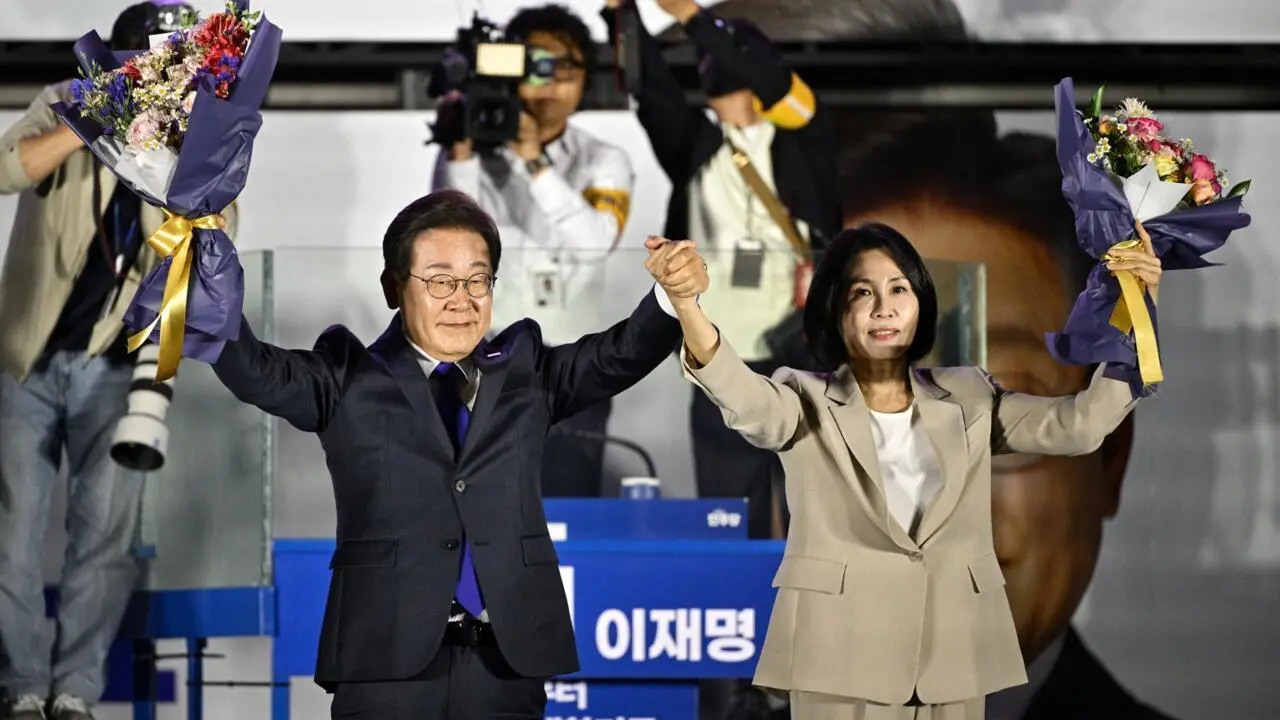
Lee Jae-myung, the leader of South Korea's Democratic Party, has won the country's snap presidential election, returning the center-left to power after a turbulent period that began with President Yoon Suk Yeol's short-lived martial law decree and ended with his impeachment and removal from office. The National Election Commission said Lee won 49.42 percent of the vote in the June 3 contest. Kim Moon-soo of the conservative People Power Party finished second with 41.15 percent, while Lee Jun-seok of the Reform Party took 8.34 percent. Turnout reached 79.4 percent, reflecting intense public interest in an election held less than two months after the Constitutional Court unanimously upheld Yoon's impeachment.
Because the election was a snap presidential contest, there was no standard transition period. Lee was sworn in on June 4, 2025, and began exercising presidential powers immediately. His victory ends a period of acting leadership and gives the Democratic Party control of the presidency for the first time since Moon Jae-in left office in 2022. It also marks a rapid reversal for Lee, who lost the 2022 presidential election to Yoon by just 0.73 percentage points, the narrowest margin in South Korean presidential history.
Key facts at a glance
- Election date: June 3, 2025.
- Winner: Lee Jae-myung, Democratic Party.
- Vote share: 49.42 percent.
- Runner-up: Kim Moon-soo, People Power Party, 41.15 percent.
- Third place: Lee Jun-seok, Reform Party, 8.34 percent.
- Turnout: 79.4 percent.
- Inauguration: June 4, 2025, with no transition period.
- Term: Five years, with no re-election under the constitution.
Why the election took place
The election was triggered by the removal of Yoon Suk Yeol. On December 3, 2024, Yoon announced martial law in a late-night television address, accusing the opposition-controlled National Assembly of paralysing his administration and sympathizing with North Korea. Lawmakers rushed to the assembly, voted to lift martial law within hours, and later launched impeachment proceedings. The National Assembly impeached Yoon on December 14, 2024. On April 4, 2025, the Constitutional Court unanimously upheld the impeachment, formally removing him from office. Under the constitution, a new presidential election had to be held within 60 days.
The crisis reshaped South Korean politics. It raised questions about democratic institutions, civilian control of the military, and the resilience of the country's political system. It also deepened polarization between conservatives and liberals, with each side offering competing interpretations of the martial law episode and the events that followed. Lee campaigned as a candidate who could restore stability, hold the government accountable, and address the economic and social grievances that had fuelled public anger.
From factory floor to presidential office
Lee's personal story is one of the most unusual in South Korean politics. He was born on December 22, 1964, in Andong, North Gyeongsang Province, and grew up in Seongnam, a city south of Seoul. His family was poor, and he left school as a teenager to work in factories. He has said that he suffered a workplace accident that damaged his hearing and shaped his understanding of labor rights and social inequality. He later earned a high school equivalency certificate and studied law at Chung-Ang University, where he passed the bar examination.
Before entering electoral politics, Lee worked as a human rights lawyer, representing workers and civic activists. He entered politics in the 2000s and served as mayor of Seongnam from 2010 to 2018. As mayor, he promoted welfare programs, youth policies, and urban development projects, gaining a reputation as a pragmatic and sometimes combative administrator. He then served as governor of Gyeonggi Province from 2018 to 2021, overseeing the most populous province in South Korea and expanding his national profile.
In 2022, Lee ran for president as the Democratic Party candidate. He lost to Yoon Suk Yeol by a razor-thin margin, a result that left the country deeply divided and set the stage for confrontational politics. After the defeat, Lee remained a central figure in the Democratic Party and became its leader. In January 2024, he was stabbed in the neck during a public event in Busan. He survived the attack and returned to politics, later leading his party to a strong performance in the April 2024 National Assembly election.
Legal battles and political controversy
Lee's career has been shadowed by legal proceedings and corruption allegations. He has faced multiple investigations and trials related to land development projects, election-law violations, and other matters. In November 2024, a lower court convicted him of violating the Public Official Election Act over statements made during the 2022 presidential campaign and sentenced him to a suspended prison term. An appellate court acquitted him in March 2025. Lee has consistently denied wrongdoing and has described the cases as politically motivated. The legal disputes remained a major theme of the presidential campaign and are likely to continue to shape his presidency.
His opponents argued that the cases raised questions about his fitness for office. His supporters countered that the investigations were part of a broader effort by conservative prosecutors and political rivals to weaken him. The election result did not resolve that argument, but it gave Lee a national mandate and control of the presidency, even as the judicial process continued to cast a shadow over his political future.
What Lee has promised
Lee campaigned on a platform focused on economic recovery, social welfare, and national reconciliation. He promised to support small businesses and self-employed workers, expand housing supply, strengthen the social safety net, and promote what he calls a more fair economy. He has long advocated a form of universal basic income, arguing that direct cash payments and stronger welfare policies can reduce inequality and stimulate domestic demand. He also pledged to invest in artificial intelligence, semiconductors, and other strategic industries to keep South Korea competitive.
On energy and climate policy, Lee has called for a faster transition to renewable energy while managing the costs for households and businesses. He has promised to improve labor protections and to address the dangers faced by workers in small and medium-sized enterprises. On social policy, he has emphasized youth employment, child care, and support for an aging population. He has also spoken about decentralizing power away from Seoul and strengthening local economies.
In his victory speech, Lee emphasized unity and promised to govern for all South Koreans, including those who did not vote for him. He said his priority would be to restore livelihoods, reduce political conflict, and rebuild trust in government. The scale of that task is considerable. South Korea faces slowing growth, high household debt, an aging society, rising housing costs, and a deeply polarized political landscape.
Domestic challenges
Lee inherits a country that is economically anxious and politically divided. Although the Democratic Party has been the largest force in the National Assembly, the conservative opposition remains strong, and the new president will need to build coalitions to pass major legislation. The impeachment crisis has left deep scars, and many conservative voters view Lee's presidency with suspicion. At the same time, liberal voters expect him to deliver on promises of accountability and reform.
The new president must also manage the fallout from the martial law episode. Public trust in institutions has been shaken, and there are ongoing debates about how to prevent a future president from concentrating power or using the military against political opponents. Lee has promised to strengthen democratic safeguards, but any such reforms will require careful negotiation with the assembly and the public.
On the economic front, Lee faces pressure to ease the cost of living while maintaining fiscal discipline. South Korea's export-driven economy is vulnerable to global trade tensions, supply-chain disruptions, and competition from China. The promise of industrial investment and welfare expansion will have to be balanced against budget constraints. The country's rapidly aging population adds further strain on pensions, health care, and social services.
Foreign policy and security
Lee's foreign policy is expected to emphasize pragmatic diplomacy and national interest. He has said he will maintain South Korea's alliance with the United States as the foundation of security while seeking to manage relations with China and Japan carefully. He has also called for renewed engagement with North Korea, arguing that dialogue and deterrence should go together. That approach may differ in tone from the more hardline stance of the previous government, but it is unlikely to produce a dramatic break with Washington or Seoul's broader security posture.
The regional environment is difficult. North Korea has continued to advance its missile and nuclear programs, and ties with Japan remain sensitive despite recent efforts at cooperation. The United States is pressing allies on defense spending and trade, while China is South Korea's largest trading partner. Lee will need to navigate these pressures while reassuring voters that he can protect the country's security and economic interests.
Immediate tests for the new president
Lee's victory is a major comeback for a politician who lost the presidency by a tiny margin, survived a violent attack, and fought multiple legal battles. It also reflects public fatigue with the confrontational style of the previous administration and widespread concern about economic fairness. The result does not end South Korea's polarization, but it gives the country a new leader with a clear mandate to address domestic grievances and restore confidence in democratic institutions.
Lee's five-year term began immediately after the election, with no transition period and little time for preparation. His early decisions on appointments, economic policy, and relations with the National Assembly will set the tone for his presidency. The country's institutions, economy, and alliance relationships will all be tested in the months ahead. The constitution limits the president to a single five-year term, so Lee will have to move quickly if he wants to turn his campaign promises into durable change.
Source:France 24 News