

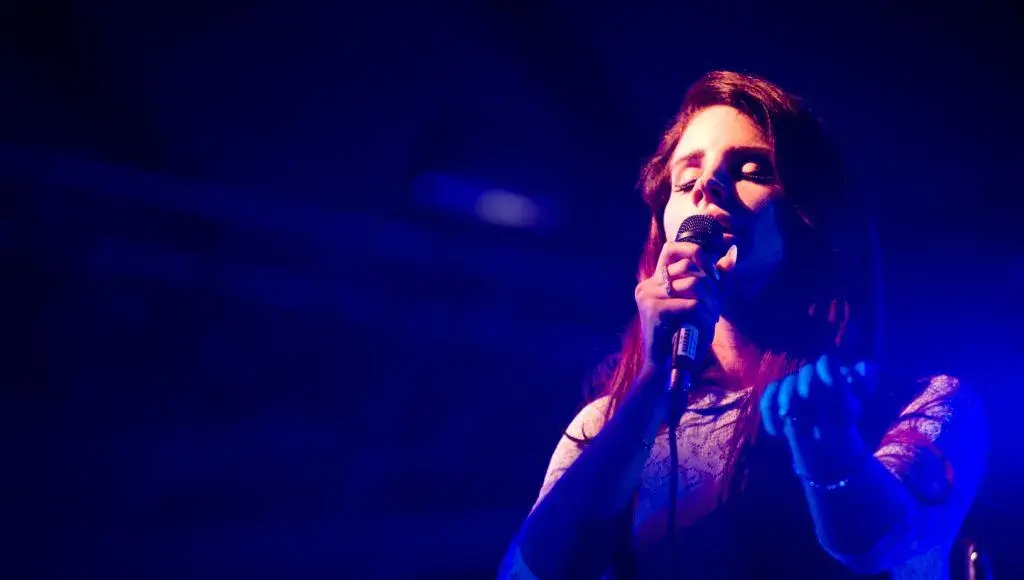
Lana Del Rey, born Elizabeth Woolridge Grant on June 21, 1985, in New York City, has become one of the most enigmatic and influential figures in modern music. Often described as the "girl next door who became an icon of a fantasized and disenchanted America," her journey from obscurity to global stardom is as complex as the characters she portrays in her songs. Del Rey's music is a tapestry of melancholic nostalgia, cinematic references, and a deep, often critical, love for American culture.
Del Rey's early life was marked by a move to upstate New York and later to Lake Placid, where she attended boarding school. It was here that she developed a love for poetry and songwriting, often citing artists like Bob Dylan, Leonard Cohen, and Frank Sinatra as influences. After a period of struggle in New York City, including a brief stint living in a trailer park, she began releasing music under different monikers, including Lizzy Grant and May Jailer. It wasn't until 2011, with the release of her self-titled music video for "Video Games," that the world took notice. The low-budget, homemade video, featuring vintage footage and Del Rey's haunting vocals, went viral and set the stage for her debut album.
The Birth of a Persona
"Born to Die" (2012) was a commercial success but critically divisive. Critics questioned the authenticity of her persona, which melded a glamorized, tragic femininity with references to 1950s and 1960s Americana. However, the album's lush, trip-hop-influenced production and Del Rey's sultry delivery won over a massive audience. Songs like "Blue Jeans" and "Summertime Sadness" became anthems for a generation grappling with a similar sense of disillusionment. The album explored themes of doomed romance, American decay, and the seduction of the past, all delivered with a calculated aesthetic that felt both ironic and sincere.
Del Rey's persona was a deliberate construction. She drew from the iconography of Marilyn Monroe, the poetry of Allen Ginsberg, and the road movies of David Lynch. Her lyrics often painted a picture of a woman in love with a dangerous, masculine America—the gangster, the bad boy, the outlaw. This romanticization was not without critique; many accused her of glamorizing toxic relationships and perpetuating a regressive view of femininity. Yet, Del Rey defended her work as exploring emotional truth and the complexities of American identity. Her second album, "Ultraviolence" (2014), produced by Dan Auerbach, leaned heavily into a psychedelic, rock sound, with lyrics that delved deeper into domestic violence and addiction. The album was a critical step forward, showcasing her range as a songwriter and vocalist.
Artistic Evolution and Critical Acclaim
With "Honeymoon" (2015), Del Rey fully embraced her cinematic style, drawing from jazz, trip-hop, and baroque pop. The album was a slow-burn exploration of love and isolation, with tracks like "Terrence Loves You" and "The Blackest Day" revealing a vulnerability that moved critics. Her fourth album, "Lust for Life" (2017), marked a shift toward a more hopeful, politically conscious perspective. Featuring collaborations with The Weeknd, A$AP Rocky, and Stevie Nicks, the album touched on environmentalism, generational angst, and the search for meaning in a chaotic world. The title track, with its refrain "We are the wild ones, young and restless," was a departure from her usual fatalism, hinting at a desire for change.
The critical turning point came with "Norman Fucking Rockwell!" (2019). Many critics hailed it as her masterpiece. Produced by Jack Antonoff, the album was a sprawling, piano-driven collection that synthesized Del Rey's obsessions with American landscapes, toxic masculinity, and the California dream. Songs like "Mariners Apartment Complex" and "Venice Bitch" were praised for their poetic depth and sonic richness. The album earned Del Rey her first Grammy nominations for Album of the Year and Best Alternative Music Album. It was also a cultural touchstone, sparking conversations about the role of the female artist and the politics of nostalgia.
2021's "Chemtrails over the Country Club" continued in this vein, exploring themes of community, identity, and the illusion of the American dream. The title track referenced the conspiracy theories of chemtrails, using them as a metaphor for the hidden structures that control our lives. "Blue Banisters" (2021), released later that same year, was a more stripped-back, piano-focused album that dealt with friendship, family, and artistic independence. Del Rey's prolific output during this period demonstrated a restless creativity and a refusal to be pigeonholed.
The Phenomenon of Disenchantment
Del Rey's work is often described as a soundtrack for a disenchanted America. She channels the mourning for a lost past—mythic and cinematic—that never actually existed. Her songs are populated with references to old Hollywood, Route 66, and faded motels, all wrapped in a haze of melancholy. This perspective resonates with listeners who feel alienated by the modern world, longing for a simpler, more romantic era even as they recognize its emptiness. Del Rey's genius lies in her ability to embody this paradox: she is both the sad girl next door and the glamorous star, the victim and the seducer, the patriot and the critic.
Her 2023 album "Did you know that there's a tunnel under Ocean Blvd" is a sprawling, introspective work that blends her signature style with gospel, spoken word, and ambient influences. The album delves into her family history, her relationship with fame, and her spiritual struggles. Tracks like "A&W" (American Whore) are unflinching in their examination of sexual double standards and the commodification of the female body. The album further cemented her status as a thoughtful, unapologetic artist who refuses to conform to industry expectations.
Influence and Legacy
Lana Del Rey's influence on popular culture cannot be overstated. She has inspired a generation of artists, from Billie Eilish and Halsey to Taylor Swift, who have adopted her aesthetic of melancholic pop and confessional songwriting. Her visual style—vintage dresses, cherry prints, and retro cars—has been widely imitated, and her concept of the "sad girl" has become a cultural trope. Yet, Del Rey remains a divisive figure. She has been criticized for cultural appropriation, for romanticizing domestic violence, and for making controversial statements about race and feminism. She has defended herself against these accusations, often with long, emotional open letters on social media, arguing that her work is about emotional authenticity rather than political correctness.
Despite the controversies, Del Rey's artistic integrity is undeniable. She has built a world that is uniquely hers, one where the past and present collide, where beauty and pain are inextricably linked. Her music offers a space for listeners to explore their own contradictions, to embrace sadness as a valid emotional state, and to question the myths they have been sold about love and America. As she continues to evolve, releasing new music and performing sold-out shows, Lana Del Rey remains an essential voice in the cultural landscape—a true icon of a fantasized and disenchanted America.
Her ability to transform personal pain into universal art, to find beauty in decay, and to challenge the boundaries of pop music has secured her place in history. The girl next door has become a legend, and her story is far from over.
Source:France Inter News