

Key takeaways
- OpenAI Academy offers free AI courses, structured learning paths, and certificates at no cost.
- A 90-minute Agents and Workflows path combines video, screen shares, self-paced exercises, and a 20-question assessment.
- The assessment is more demanding than typical free-course quizzes, requiring full attention rather than guesswork.
- Webcasts and recorded conference sessions add a second layer of learning beyond formal coursework.
- Coverage gaps exist for the newest products, a natural consequence of AI releasing faster than curricula can be written.
Why AI fluency has become a baseline job requirement
According to aggregated industry statistics, 62% of U.S. adults aged 18 to 64 reported using generative AI as of May. A McKinsey study published last December found that 88% of organizations report using AI for at least one business function. Those two figures, taken together, describe a labor market that has already absorbed the technology rather than one still debating whether to adopt it.
In that environment, learning how to use, teach, and build with AI is no longer a differentiator reserved for specialists. It is table stakes for anyone looking for a job, and increasingly for anyone trying to hold onto one. Hiring managers now routinely ask candidates to describe how they use AI in their daily work. Teams are expected to demonstrate fluency with prompts, workflows, and increasingly with autonomous agents that carry out multi-step tasks.
The problem is that most people learn these tools through scattered experimentation, YouTube videos of wildly varying quality, and trial and error on live projects. Structured training closes that gap, but corporate courses and bootcamps often carry price tags in the thousands. That is the niche OpenAI Academy is designed to fill: free, self-paced, hands-on instruction built by the company that makes the tools.
What the free academy actually includes
OpenAI Academy is a free learning destination where users can take hands-on lessons and earn certifications. It originally surfaced alongside the company's announcement of a LinkedIn-style jobs platform, which, as of this writing, does not appear to exist publicly. The academy, by contrast, is live and usable today.
The structure is straightforward. Courses are organized into learning paths, which are chains of training elements that build on one another. A path might begin with an interactive course made up of text, embedded video, screen recordings, self-paced exercises, and hands-on project assignments that require actually opening ChatGPT and completing work. Later elements in the path assess what was learned.
For people who prefer passive learning, the academy also aggregates webcasts and conference videos that can be watched purely for personal enrichment. There is no certificate attached to those, but the material is often more current than formal coursework because it comes directly from recorded events.
Beyond courses: webcasts and conference sessions
The event library is more useful than it first appears. Sessions cover specialized applications of the tools for particular industries, including a track aimed at news organizations. One session walks through using ChatGPT for visual storytelling, covering how to turn raw data into charts and narrative graphics. For anyone who spends their working life translating spreadsheets into something an audience can understand, that kind of focused instruction is far more valuable than a generic overview of prompting.
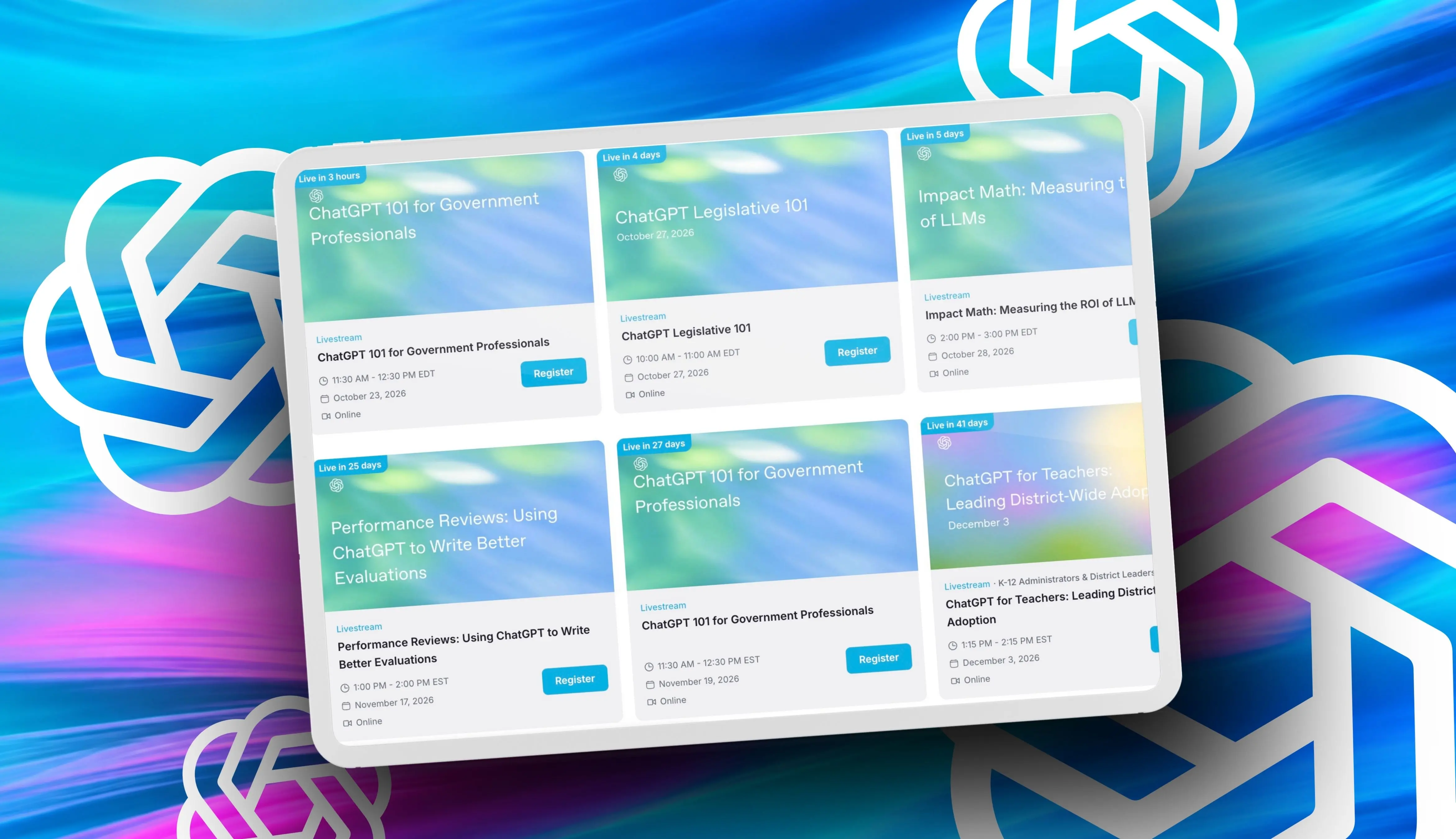
Not every event is available as a replay, which is worth knowing before diving in. The events page lists past sessions that can be watched and upcoming sessions that can be registered for in advance. Treating the events calendar as a supplement to formal coursework is the most efficient approach: courses supply the foundational structure, while webcasts fill in emerging capabilities and industry-specific techniques.
Inside the Agents and Workflows learning path
To evaluate the platform directly, the Agents and Workflows path is a reasonable test case. It takes roughly 90 minutes to complete end to end, which makes it a low-risk commitment for a working professional.
The first training element is an interactive course combining text explanations, video segments, and screen shares that show exactly where to click and what the output looks like. Self-paced exercises follow, along with project assignments that require using ChatGPT and its work-oriented features to complete real tasks. These elements map closely onto the structure of a traditional in-person course: lectures, homework, and lab projects.
The pacing is deliberate without being sluggish. The material moves quickly from defining what agents are, illustrated through a variety of workflow decision trees, all the way up to scheduling and organizing workflow projects that agents then execute. Along the way, a consistent theme is distinguishing which tasks suit an agent and which are better handled by a straightforward chat interaction. That distinction matters more than it sounds. Many failed automation attempts stem from applying an agent to a problem that needed a single well-crafted prompt, or vice versa.
The visual presentation of those concepts is one of the course's stronger features. Decision trees and side-by-side comparisons make the tradeoffs concrete rather than abstract. The course does not reach the complexity of a full production automation build, such as a customer support system handling real inbound volume, but it imparts enough grounding to feel comfortable starting a first agent project and putting it to work.
The assessment is harder than expected
The second part of the learning path is a 20-question assessment. It is more challenging than most free online courses prepare you for. The question mix includes multiple-choice items, pick-one formats, and mix-and-match exercises that require actually connecting concepts rather than recognizing familiar phrasing.
The difficulty level is worth noting because it changes the nature of the certificate. A test that can be completed absentmindedly produces a credential with little signaling value. A test that demands attention, that cannot be phoned in, produces something closer to genuine evidence of comprehension. Answering all 20 questions correctly requires having absorbed the material on agent versus chat task fit, on workflow structure, and on how to instruct an agent effectively.
That combination of instruction followed by retrieval practice is well supported by education research. Testing does not merely measure learning; it consolidates it. The fact that the assessment is engaging enough to hold full attention for its duration is a meaningful design achievement, and it makes the certificate feel earned rather than issued.
What the course gets right about instructional design
Evaluating a course against established education practices is a useful exercise for anyone considering where to spend limited learning hours. On that measure, this path performs well on two dimensions in particular: learner involvement and skills evaluation.
Involvement comes from the alternation between watching and doing. Screen recordings show the mechanics; exercises immediately require reproducing them. That cycle prevents the passive drift that afflicts video-only courses, where viewers finish a two-hour lecture and retain almost nothing actionable.
Skills evaluation comes from the assessment, which tests application rather than recall of definitions. The combination is what separates training that changes how someone works from content that merely feels educational while it is being consumed.
Where the offering falls short
The most obvious gap is timeliness. New products and features ship faster than educational materials can be written, reviewed, and published. Anyone looking for instruction on the very newest tools will often find the academy lagging by weeks or months, with coverage arriving only after a product has stabilized.
That is a structural constraint rather than a failure of effort. Curriculum development involves instructional designers, subject experts, recording, editing, and quality review; product releases involve none of that. The result is a permanent, if modest, lag between what the tools can do and what the free training explains.
A secondary limitation is depth. Learning paths are designed to build comfort and competence at the entry to intermediate level. Users hoping for advanced material on multi-agent orchestration, evaluation frameworks, or production reliability will need to look elsewhere or build that knowledge through their own projects.
How to get the most out of free AI training
The practical approach is to treat the academy as a starting point rather than a complete curriculum. Begin with a learning path tied to work you actually need to do, complete the assessment honestly, and then immediately apply one technique to a live task within a week. Retention depends far more on that application than on the course itself.
Pair coursework with the recorded event library, particularly sessions aimed at a specific industry or function. Those recordings tend to reflect what practitioners are doing now, while the formal courses reflect what has been codified.
And return periodically. Because the underlying products change quickly, a path completed six months ago will not reflect current capabilities. Revisiting the catalog, watching new sessions, and retaking updated assessments is the realistic way to keep skills current when the tooling itself is a moving target. For anyone holding a paid ChatGPT account in particular, a few hours spent inside the academy almost guarantees a better return on that subscription, a clearer understanding of how the technology actually works, and a modest but real addition to career credibility. The certificate is a pleasant artifact of that process, but the working knowledge is the point.
Source:ZDNET News