

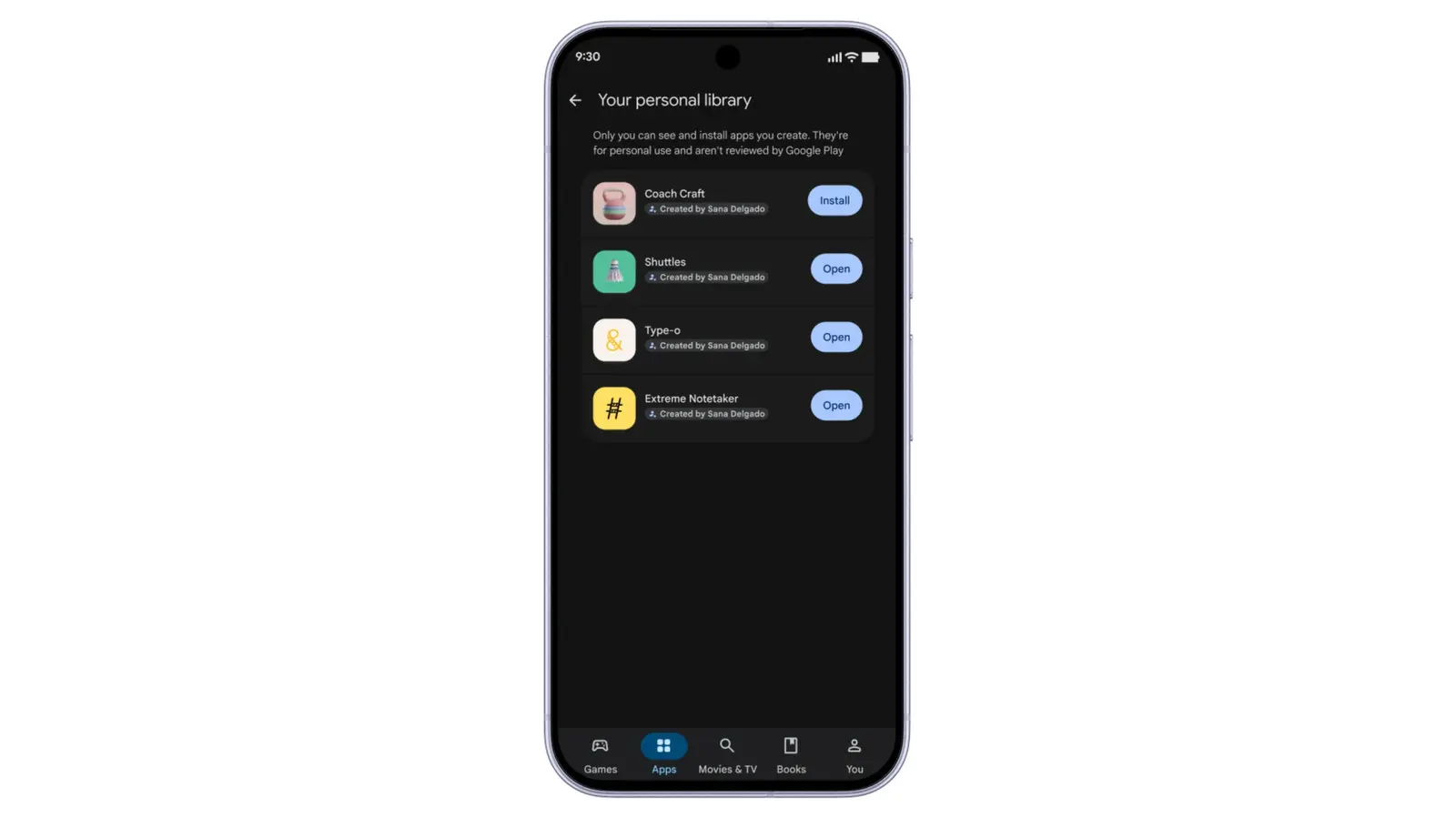
Google is preparing to lower one of the most significant barriers in Android app distribution: the requirement for a paid developer account and a formal review pipeline before an app reaches users. Under a new Play Store program, people who create Android apps through AI-assisted 'vibe coding' will be able to publish those apps with just a Google account. The change is part of a broader set of Play Store updates announced for the AI era, and it will roll out first to users in the United States and other select markets who are 18 and older.
The feature is tied to Google AI Studio, a tool that can generate app prototypes and functional apps from written prompts to Gemini. Users can refine results with additional prompts or edit the generated code directly. Instead of requiring new creators to immediately navigate professional developer registration, Google will allow them to upload an AI-generated Android app and keep it in a new 'personal library' section of the Play Store. At first, those apps will only be available on the creator's own devices, including tablets and computers with access to the Play Store.
That personal-library phase is deliberately limited. Google says it eventually plans to let creators securely share vibe-coded apps with friends and family. If a creator wants to distribute an app to a global audience, the company says there will be a path to 'graduate' to a professional developer account and submit the app to the Play Store's normal safety reviews. The structure suggests Google is trying to separate experimentation from public distribution while still using its existing review system for apps that reach broader audiences.
A new on-ramp for AI-generated apps
For years, Android has been more open than many mobile platforms. Users can sideload APK files, and developers can distribute apps outside the Play Store. But sideloading has never been a smooth or safe experience for most people. Google has also made the process more complex over the past year, adding friction intended to protect users from malicious software. The new publishing route does not remove those security concerns. It instead creates a controlled space inside the Play Store where AI-generated apps can exist before they are treated as public products.
The appeal for hobbyists and first-time creators is obvious. A person can describe an idea to Gemini, get a working Android app, adjust it with more prompts, and then see it on their own phone without buying a developer license or preparing a store listing for a global audience. That lowers the cost of experimentation and shortens the distance between an idea and a testable app. It also reflects how AI tools are changing software creation: more people can produce small apps, but far fewer are prepared to handle publishing, privacy disclosures, security reviews, and ongoing maintenance.
Google's approach acknowledges that gap. The personal library acts as a sandbox. It gives creators a place to use their own apps across devices without opening the door to public distribution. For Google, that means more Play Store activity and more experience with AI-generated software without immediately flooding the public store with unreviewed apps. For users, it means a clearer distinction between a personal experiment and an app that has passed the checks expected of a public release.
Personal library first, public store later
The initial limits are important. The program is not a blanket invitation for anyone to publish anything to the global Play Store with no review. It is an account-based path for adults in select markets to test AI-generated apps on their own devices. The device scope includes tablets and computers that can access the Play Store, which makes the feature useful for multi-device testing. A creator could build an app on a phone, try it on a tablet, and use it on a computer without going through a paid developer account.
Google's plan to add secure sharing with friends and family is the next step. That would turn the personal library into a small private distribution channel, though the company has not said exactly how sharing will be secured or moderated. The more consequential step is graduation to a professional developer account. At that point, an app would enter the normal Play Store safety reviews and become eligible for wider distribution. The word 'graduate' is telling: Google is framing public publishing as a milestone rather than the default outcome of using AI Studio.
That model could reduce the risk of low-quality or harmful apps reaching a broad audience. It could also create a two-tier system in which AI-generated apps are treated differently depending on whether they stay private or seek public release. The details of those reviews will matter. If the graduation process is too burdensome, hobbyists may stay in the personal library. If it is too loose, the Play Store could face the same quality and security problems that have long plagued open app distribution.
Why Google is making this change now
The announcement comes as Google is injecting AI into nearly every part of its products, including search, productivity tools, and the Play Store. AI Studio has made it possible for people with little or no traditional programming experience to generate working app code. At the same time, Google faces legal and regulatory pressure to open the Play Store to competitors. Third-party app stores can now be installed through the Play Store in some contexts, which gives users more alternatives and gives Google more reason to keep its own store competitive and relevant.
The new publishing route also fits a wider shift in app development. AI-assisted coding tools are lowering the technical barrier to entry, but distribution remains a separate challenge. A generated app still needs a package, a signing process, permissions, privacy considerations, and a way to reach users. By connecting AI Studio to the Play Store through a Google account, Google is trying to own more of that pipeline. It wants creators to move from prompt to personal app to public app without leaving its ecosystem.
There is also a competitive signal. Apple's App Store remains a tightly controlled marketplace, and alternative Android stores are trying to attract developers who want more flexibility. Google can present the Play Store as more open to experimentation while still keeping public distribution behind a review process. The balance is delicate. Too much friction and creators will look elsewhere. Too little and the Play Store risks losing user trust.
Discovery changes across the Play Store
Publishing is only one part of the update. Google is also changing how people find apps and games. The company introduced its biggest discovery change, Ask Play, at its developer conference earlier in 2026. Now it is bringing similar capabilities to Gemini by allowing the AI assistant to surface direct links to Play Store apps in chats. That means a conversation about a task, a hobby, or a problem could lead directly to an app recommendation without the user opening the store and searching manually.
Google is also expanding its sports topic pages, which appear in the Play Store during live matches. Those pages will now cover soccer games from the Premier League, Major League Soccer, and more. The idea is to meet users at the moment of interest, when they are watching a match and may want related apps, games, or content. In cars with Google built-in and on Android XR, Google is updating the Play Store layout to better fit the size of the physical or virtual screen. That is a recognition that the Play Store is no longer just a phone app; it is appearing across more surfaces and form factors.
These discovery changes may be less visible than the publishing shift, but they matter for developers. More AI-driven recommendations could help smaller apps find audiences, or it could concentrate attention on apps that Google's systems already understand well. The outcome will depend on how the recommendations are ranked, how transparent they are, and whether users feel that the suggestions are useful rather than intrusive. The addition of Gemini links is especially significant because it puts app discovery inside a conversational interface that Google is positioning as a central assistant.
Games get new recommendation and engagement tools
For players, Google is adding a Game Finder feature that recommends titles based on individual taste. The company says the recommendations are powered by a Gamer DNA profile, a new taste profile that users can fine-tune with preferences and favorite genres. In a roundtable with press, Google suggested it hopes to make filters and genre tags more granular over time. That could eventually allow users to drill down into specific attributes, such as games that offer controller support.
Google is also introducing game playlists, which let users recommend a collection of mobile games for other people to try. The feature turns recommendations into shareable lists rather than one-off suggestions. That could help players discover titles through friends and communities, and it gives developers another way to be surfaced by people who already enjoy similar games. The effectiveness will depend on how easy the playlists are to create and find, and whether they become a meaningful discovery channel rather than a novelty.
The company is updating the overall experience of playing games on Android as well. Its Sidekick overlay has a new feature that can record 30-second clips of gameplay. Developers are also receiving new tools intended to increase engagement. These include Sprints, Community Posts, and an expansion of the Quests feature. Sprints are 48-hour in-game challenges that match players of similar skill levels to compete for the highest score. That format is designed to create short, repeatable events that can bring players back without requiring a long-term commitment.
Quests previously allowed developers to reward players with Play Points. Now they can also provide in-game rewards, which gives developers more flexibility in how they motivate players. Community Posts adds a Q&A section to store pages so players can ask and answer questions about games in the Play Store. That could reduce the distance between developers and players, though it also creates a new surface that will need moderation. Together, the tools show Google trying to make the Play Store more than a download hub by adding social, competitive, and feedback features around games.
The stakes for Android distribution
The helpfulness of these changes depends heavily on trust. Users must trust AI to build apps that work and respect privacy. They must trust AI recommendations to surface useful apps rather than ads or low-quality titles. Developers must trust Google to keep the rules clear and the review process fair. The new publishing route is a test of all three. It gives AI-generated apps a legitimate path into the Play Store, but it also raises questions about quality control, security, and the long-term shape of the app economy.
For Google, the move is a way to stay competitive as third-party app stores become more accessible and as AI tools change who can build software. The company is trying to turn AI-assisted creation into a pipeline that starts in AI Studio and ends in the Play Store. Whether that pipeline becomes a thriving ecosystem for small creators or a source of new moderation challenges will depend on how the graduation process works, how sharing is secured, and how users respond to AI-driven discovery. The company is betting that a lighter on-ramp will bring more people into Android development without turning the public store into an unchecked free-for-all.
Source:Engadget News