

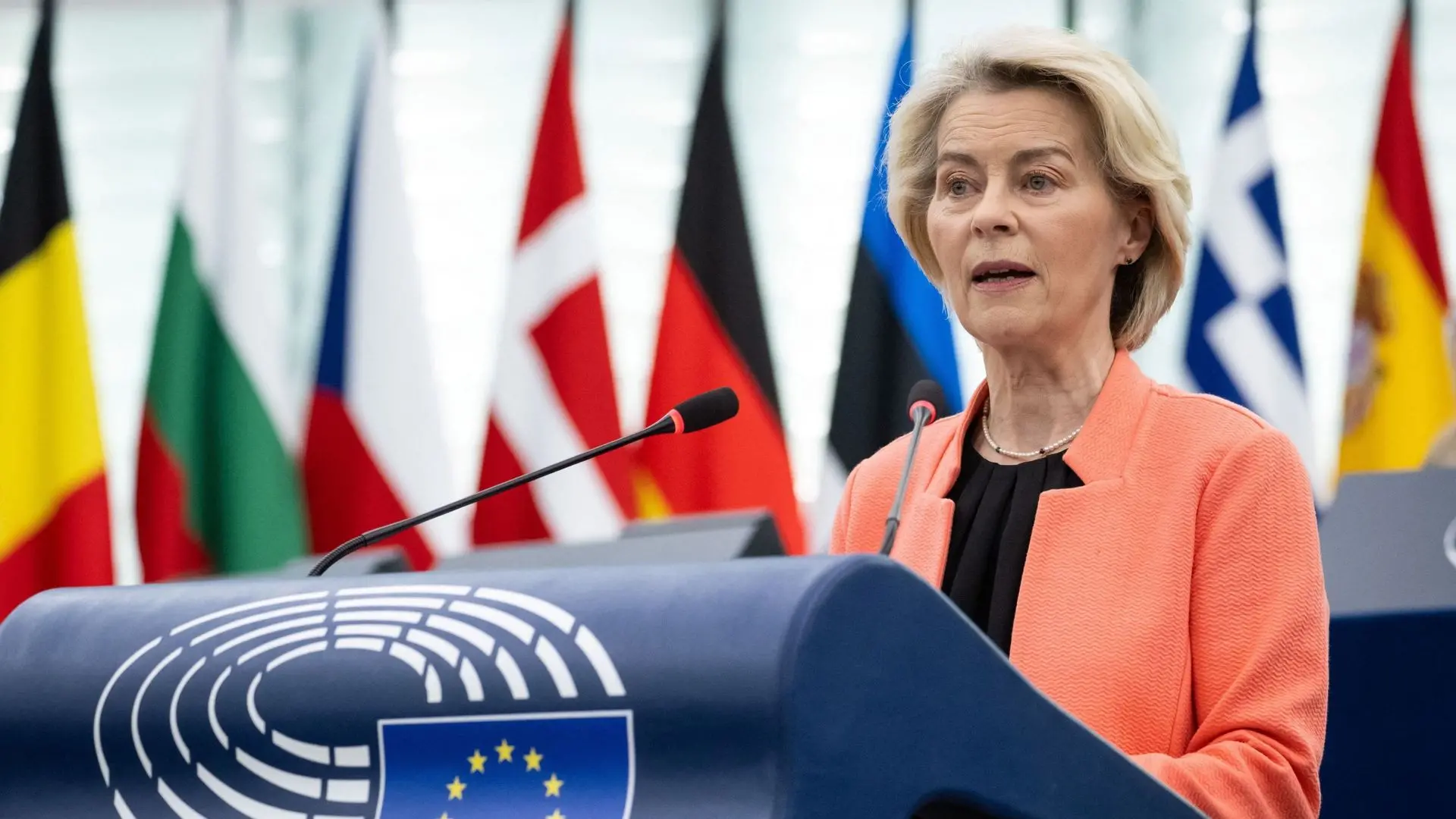
Von der Leyen turns State of the Union into a public campaign
Ursula von der Leyen is preparing to deliver one of the most closely watched speeches on the European Union calendar, the State of the Union address, with her team working to take the message far beyond the usual Brussels audience. The European Commission president has used social media, invited influencers and dropped carefully chosen hints in the run-up to the address, while keeping the central content under wraps. The aim is to create a public moment around a speech that can otherwise feel remote from everyday life, and to frame the political priorities that will shape the Commission's agenda in the months ahead.
The build-up has been unusually promotional for a set-piece institutional speech. Rather than allowing the address to be defined by leaks or by the immediate reactions of lawmakers, von der Leyen's entourage has tried to control the narrative, offering teasers that point to the themes she intends to develop. The strategy reflects a broader shift in European politics: leaders are increasingly trying to communicate directly with citizens, bypassing traditional filters and speaking in the language of social platforms. The speech itself will still be delivered to the European Parliament, but its intended audience extends well beyond the chamber.
EU Kids Act set to be central announcement
Among the most concrete measures expected in and around the speech is the EU Kids Act, a proposed regulation on the protection of minors online. According to a draft reported before its official presentation, the plan would set 15 as the minimum age at which a child is allowed to create an account on the type of services covered by the legislation. The same draft would allow minors from the age of 13 to create accounts with limited functionality if they obtain permission from a parent or guardian. The proposal is due to be presented officially on Thursday, and von der Leyen is expected to reference it in her Wednesday address.
The measure would mark a significant attempt to harmonise rules across the European Union at a time when member states are moving at different speeds. Some governments favour a straightforward ban on social media accounts for children under 15 or 16. Others prefer to regulate the design of platforms used by young teenagers, arguing that age limits alone are difficult to enforce and can push young people towards less regulated corners of the internet. The draft appears to seek a compromise, combining a higher general age threshold with a supervised pathway for younger teenagers.
The political significance of the proposal goes beyond one age limit. It touches on questions of privacy, parental responsibility, platform accountability and the practical mechanics of age verification. Any system that requires proof of age raises concerns about data protection and about whether young people will be able to access anonymous spaces. Any system that relies on parental consent raises questions about children whose parents are absent, unwilling or unable to supervise their online lives. And any system that places obligations on platforms raises the issue of enforcement, especially when services are designed and operated globally.
Why online safety is moving up the agenda
The EU Kids Act arrives as concerns about the safety of minors online have become more urgent. Tech workers themselves have voiced anxiety about the pace of artificial intelligence development and about the ways in which powerful systems can be deployed before their social consequences are fully understood. For parents, teachers and regulators, social media is no longer treated simply as a source of entertainment or a digital meeting place. It is also seen as an environment in which children can be exposed to harmful content, grooming, bullying, addictive design and commercial pressure.
European policy has already moved in this direction through broad digital rules, but the question of age-specific safeguards remains contested. The draft regulation would create a clearer legal baseline for the kinds of services young people use most. It would also force a debate about how platforms should adapt their products for teenagers, rather than simply requiring them to tick a box confirming that they are old enough. That debate is likely to intensify once the proposal is published and sent to the European Parliament and national governments.
A personal story about Ukrainian children
Von der Leyen has also used the pre-speech period to signal that the address will not be limited to legislation. In one social media post, she said that when courage and strength are needed, people should turn to children, because in them can be found the purest passion for life. She described Ukrainian children as a powerful example and said that in the State of the Union speech she would tell a story that had deeply moved her. The remark suggests that the address will blend policy announcements with emotional testimony, using individual human stories to illustrate the wider stakes of European decisions.
The reference to Ukrainian children is particularly charged. Russia's full-scale invasion of Ukraine has shaped European politics for more than three years, affecting security policy, energy markets, migration and the EU's relationship with the United States. Millions of Ukrainians, including children, have been displaced, and many have experienced loss, separation and trauma. By placing their experience at the centre of her speech, von der Leyen can connect the technical work of the Commission to the moral case for continued support for Ukraine and for a hard line against Russian aggression.
Russia and hybrid threats dominate security agenda
The security dimension is expected to be one of the most closely watched parts of the address. In the days before the speech, von der Leyen used social media to warn about hybrid attacks threatening Europe. She argued that these were not isolated incidents but part of a broader pattern of Russian aggression and provocation against Europe, designed to test the bloc's preparation and determination. She said Russia would face an ever-stronger determination, that the EU was strengthening collective deterrence and defence together with NATO, and that pressure on Russia was being intensified.
Hybrid threats can take many forms, including cyberattacks, sabotage, disinformation, interference in elections and attempts to disrupt critical infrastructure. They are often designed to stay below the threshold of conventional armed conflict while still causing damage, confusion and fear. For the European Union, the challenge is to respond collectively when national security remains largely in the hands of member states. The speech is likely to be used to argue that Europe must invest in resilience, improve coordination and treat foreign interference as a strategic problem rather than a series of unrelated incidents.
The emphasis on Russia also reflects a wider shift in European politics. Defence spending, industrial capacity and military readiness have moved from the margins of EU debate to its centre. NATO's role remains central, but the EU has been seeking to complement it through joint procurement, support for defence industries and measures against sanctions evasion. Von der Leyen's remarks suggest that she will present the response to Russia as a test of European unity and of the bloc's ability to act as a geopolitical actor.
A difficult summer shapes the political backdrop
The State of the Union address comes after a summer marked by several overlapping crises. Climate change has brought extreme weather and renewed pressure for ambitious environmental policy. Migration remains a divisive issue, with member states disagreeing over border controls, asylum rules and solidarity. Wars in the Middle East have exposed deep differences inside Europe and raised questions about the EU's influence in the region. At the same time, far-right parties have continued to gain ground in several countries, reshaping national politics and putting pressure on mainstream parties to adopt tougher positions on identity, security and immigration.
Economic questions are also likely to feature prominently. The European Union has been trying to improve its competitiveness against the United States and China, while households and businesses continue to face high energy costs. The Commission has promised to reduce regulatory burdens, support clean industry and strengthen the single market, but the resources available are limited and the political trade-offs are difficult. Von der Leyen will need to persuade both the European Parliament and national governments that her priorities are coherent, affordable and capable of delivering results before the next European elections.
The challenge of reaching beyond Brussels
The pre-speech publicity campaign shows that von der Leyen is aware of the risk that a State of the Union address can be quickly forgotten outside the EU institutions. By using influencers, social media teasers and human stories, she is trying to create moments that travel across borders and resonate with people who do not follow the details of EU policy. That approach can help to humanise the Commission, but it also raises expectations. If the speech is heavy on slogans and light on delivery, the public may conclude that the outreach was more effective than the policy.
The EU Kids Act will be an early test of that balance. It is a concrete proposal with a clear message about protecting children, but its success will depend on details that are often invisible in a speech: how age verification works, how parental consent is granted, how platforms are monitored and how national authorities enforce the rules. The same is true of security policy, where declarations of determination must be matched by funding, coordination and legal instruments. And it is true of economic policy, where calls for competitiveness must be translated into decisions that businesses and workers can feel.
For now, the speech remains a carefully staged political moment. The Commission president has set out a series of signals, from the EU Kids Act to the warning on Russian hybrid attacks, and she has promised a personal story about Ukrainian children. The final address will show how those elements fit together, and whether the attempt to reach beyond the European bubble can produce a message that is both popular and credible. The answer will shape not only the immediate news cycle but also the political authority von der Leyen carries into the next phase of her term.
Source:RTBF News