

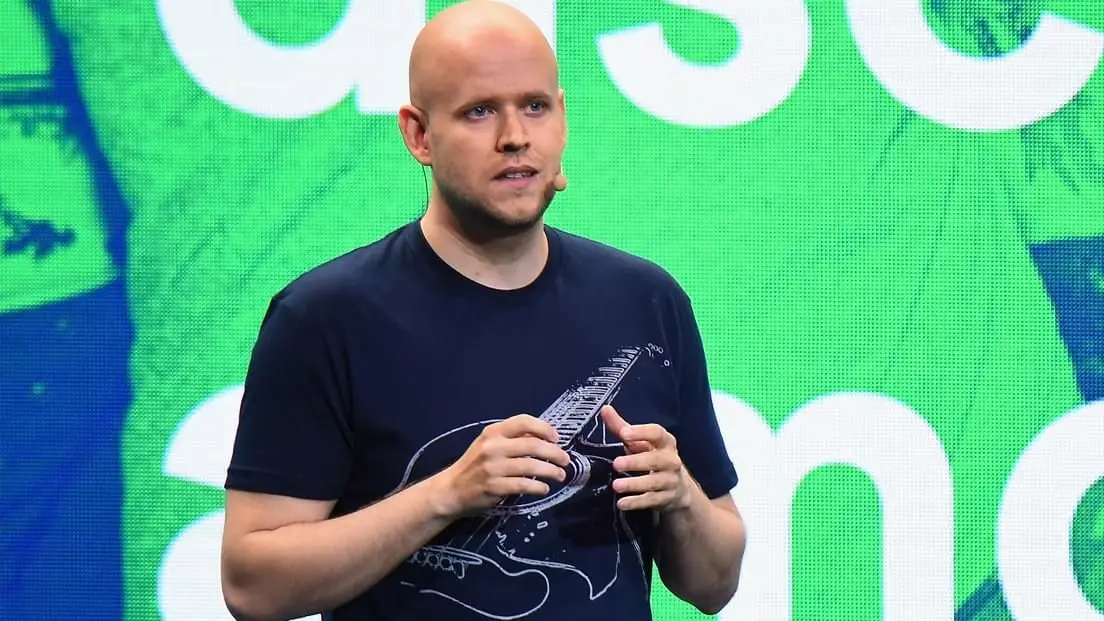
Key facts
- Daniel Ek was born in Stockholm in 1983.
- At five he received a guitar and a computer, foreshadowing his twin passions for music and technology.
- By 13 he was building websites; as a high schooler he reportedly earned about €15,000 a month.
- At 16 he applied to Google and was rejected; he later built and sold a search engine to a Swedish company.
- He enrolled at KTH Royal Institute of Technology but left after eight weeks.
- He founded a marketing company, sold it, bought a red Ferrari Modena, then retreated to a forest cabin amid depression.
- With Martin Lorentzon he founded Spotify in 2006.
- Spotify went public on April 3, 2018, making Ek a billionaire.
- Spotify became the world's leading music streaming service, with about 3,000 employees and €4 billion in revenue at the time described.
- Ek owned nearly 10% of Spotify and reportedly earned $2 billion from the IPO.
- He married Sofia Levander in August 2016 at Lake Como; guests included Mark Zuckerberg, Bruno Mars and Chris Rock.
- In 2015 Taylor Swift removed her music from Spotify before returning; Ek stayed largely quiet during the dispute.
Daniel Ek's life reads like a parable for the digital age: a child who receives a guitar and a computer at five years old, learns to code while his classmates are still painting with watercolors, and grows up to fuse music and technology into one of the most powerful platforms in the world. Born in Stockholm in 1983, Ek was not merely precocious; he seemed almost predestined for a life at the intersection of sound and software. His early fascination with MTV music videos hinted at a future in music, while his rapid grasp of programming pointed toward the internet economy that would later make him a billionaire.
Yet the path from Swedish childhood to Spotify founder was neither linear nor purely triumphant. It included astonishing early success, a costly Ferrari, a period of depression in a forest cabin, and a partnership that turned a vague idea about accessible music into a global streaming giant. Ek's story is also a case study in how the music industry was forced to reinvent itself after piracy, digital downloads, and changing consumer habits shattered the old record-business model.
Early aptitude for music and code
Ek's parents were not technology executives or music-industry insiders. His father was a mechanic and his mother worked as a childminder, according to the biographical details that have circulated around his rise. That ordinary background makes his early self-taught skills all the more striking. By the time he was a teenager, Ek was already building websites with unusual commercial success. At 13, he created some of his first internet sites, and the work attracted attention from companies that recognized his talent.
The young Ek soon launched his own business, undercutting competitors who charged as much as $50,000 for website creation. He reportedly offered similar services for a tenth of the price. While still in high school, he was said to be earning around €15,000 a month, more than both of his parents combined. This early experience taught him lessons that would reappear at Spotify: speed, cost discipline, and the willingness to challenge established pricing models.
His precocity did not always translate into institutional success. At 16, he applied to Google and was turned away, with the suggestion that he should finish his studies. Rather than accept the rejection as final, Ek built a search engine and sold it to a Swedish company, a move that looked like personal vindication. He also enrolled at KTH Royal Institute of Technology, one of Stockholm's leading engineering schools, but he lasted only eight weeks. The classroom could not keep pace with his ambition or his confidence in his own ability to learn by doing.
First ventures and a Ferrari
Before he was 20, Ek had founded a third company, this time in marketing, and sold it for a significant sum. The sale made him a millionaire and allowed him to buy something he had long dreamed about: a cherry-red Ferrari Modena. It was a symbol of arrival, proof that a young geek could enjoy the same conspicuous lifestyle as a professional athlete or a pop star. But the purchase also exposed a tension in Ek's character. He quickly discovered that sudden wealth did not bring the satisfaction he had imagined.
He abandoned the apartments and expensive cars and moved into a cabin lost in the Swedish forest. There, he sank into a slow depression. The image is striking: the newly rich tech prodigy retreating from the world, spending his days with an old friend he had somewhat neglected, his guitar. Music, which had fascinated him since childhood, became a way back to himself. It was during this period of withdrawal that the raw material for Spotify began to take shape.
Ek's path crossed again with Martin Lorentzon, a business figure to whom he had sold software two years earlier. Lorentzon was also at a crossroads and wanted to leave his old life behind. The two men spent long days watching films and listening to music until a powerful idea emerged: a platform where all songs would be accessible without downloading. They saw it as the future of music, a way to refresh an industry that was becoming increasingly moribund.
Spotify and the streaming revolution
In 2006, Ek and Lorentzon founded Spotify. The timing was significant. The music industry was reeling from the disruptive effects of digital piracy, peer-to-peer file sharing, and the collapse of CD sales. Apple's iTunes had shown that consumers would pay for digital music, but the download model still felt cumbersome and limited. Streaming promised something different: instant access to a vast catalog, legal and convenient enough to compete with piracy.
Spotify's early years were not easy. Ek poured his savings into the project, and by 2008 he reportedly had nothing left from his earlier successes. The company had to negotiate complex licensing deals with record labels, music publishers, and artists, all of whom were wary of a new technology that might further erode their revenue. Spotify also had to build a service that could scale globally, with the kind of reliability and speed that users expected from the internet.
The bet paid off. Spotify combined a free, advertising-supported tier with paid subscriptions, a freemium model that attracted millions of users while gradually converting them into paying customers. It invested in playlists, discovery tools, and user experience, turning music listening into a personalized, data-driven activity. By the time it had become the world's leading music streaming service, Spotify employed around 3,000 people and generated €4 billion in revenue, according to the figures reported in Ek's story.
Public markets, power and privacy
On April 3, 2018, Spotify went public, making Daniel Ek a billionaire. He held nearly 10% of the company's capital and reportedly earned $2 billion from the listing. The public offering was not just a financial milestone for Ek; it was a validation of the streaming model he and Lorentzon had championed more than a decade earlier. Spotify had survived the skeptics, the licensing battles, and the long years of losses to become a central institution in global music.
With success came proximity to power. For his marriage to Sofia Levander in August 2016, Ek invited guests to the shores of Lake Como, including Mark Zuckerberg, the singer Bruno Mars, and the comedian Chris Rock. Levander had herself tasted celebrity through a Swedish reality television show in the early 2000s. The wedding guest list reflected Ek's new status as a tech leader whose social circle extended far beyond Stockholm.
Yet Ek has generally remained discreet, avoiding the media spotlight even when he was drawn into controversy. In 2015, Taylor Swift removed her music from Spotify before later returning, a dispute that highlighted tensions between artists and streaming platforms over compensation and control. Ek stayed largely quiet during the episode, refusing to turn it into a personal public battle. His preference has been to let the product and the company's growth speak for themselves.
That approach fits the philosophy he has articulated in formal documents. In a filing with the Securities and Exchange Commission, he wrote that "we believe we can improve the world, one song at a time." For Ek, the mission is not merely to distribute music but to shape how it is discovered, consumed, and valued in the digital age. From the forests of Sweden to the floor of the New York Stock Exchange, his journey remains a defining story of how a gifted coder with a guitar became one of the most influential figures in the modern music business.
Source:Vanity Fair News