

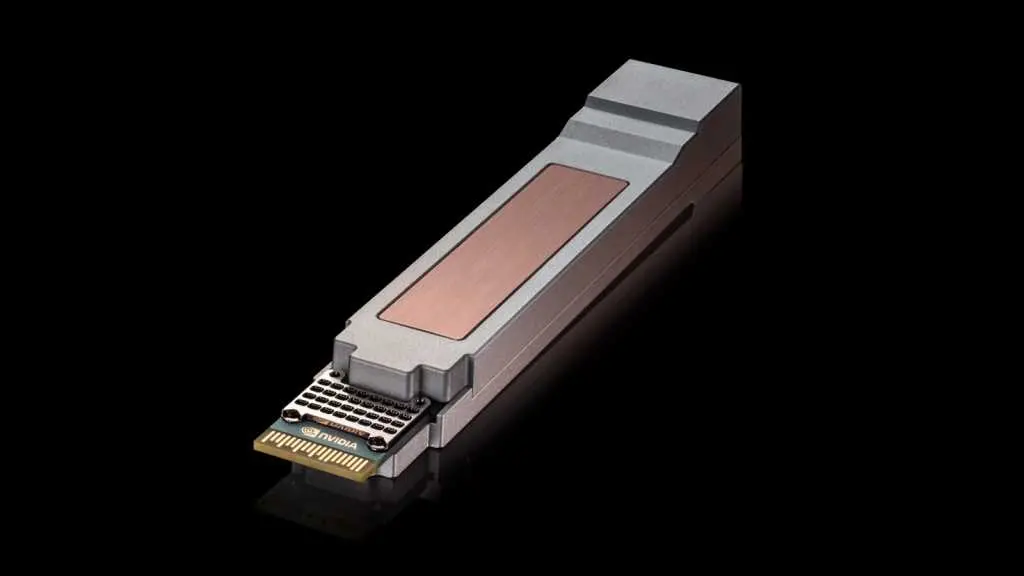
Cisco and Nvidia have introduced a new high-capacity pluggable optical module designed to make it easier and faster for customers to build Ethernet-based AI fabrics. The companies announced the Ultra-Dense Small Form Factor Pluggable, or USFP, module at the Open Compute Project Global Summit 2026. The technology is aimed at the connections between GPUs, switches, security appliances and other systems that are under increasing strain as AI workloads grow.
Cisco said USFP supports 400 Gb/s electrical signals per lane and can scale to 12.8T of aggregate capacity. The design is intended to address the bandwidth density pressure created by AI infrastructure, where more capacity is needed per connection and more connections are needed per switch. By increasing bandwidth density, customers can build higher-capacity systems without increasing the physical footprint of connectivity hardware at the same rate.
Key facts at a glance
- Cisco and Nvidia announced USFP at the OCP Global Summit 2026.
- USFP supports 400 Gb/s per lane electrical signaling.
- A 16-lane design delivers 6.4T of aggregate capacity, which the companies describe as four times the bandwidth density of today's 1.6T pluggables.
- The architecture can scale to 32 lanes for 12.8T of aggregate capacity.
- USFP supports systems and ASICs built on 200G and 400G SerDes.
- The companies expect roughly 1.3x greater power efficiency through 400G SerDes technology.
- The module is designed to preserve field serviceability and familiar pluggable-optics operations.
- Cisco and Nvidia plan to create an open industry specification through a community-led multi-source project.
- Cisco also expanded its Silicon One portfolio with the G302 top-of-rack switch chip and two new 64-port switches.
What USFP changes for Ethernet AI fabrics
USFP is built around the idea that AI data centers need denser optical connectivity without abandoning the operational model that network teams already know. Pluggable optics are widely deployed because they can be replaced in the field and because they fit established deployment and maintenance practices. USFP is intended to keep those advantages while pushing capacity per module much higher.
According to Cisco, the 16-lane version can operate at 400 Gb/s per lane and deliver 6.4T of aggregate capacity. That is four times the bandwidth density of current 1.6T pluggables. The architecture can then scale to 32 lanes, providing a path to 12.8T of aggregate capacity. The design also supports both 200G and 400G SerDes-based systems and ASICs, so customers can move from today's 1.6T fabrics to higher-capacity designs without a complete break from existing technology.
The power efficiency claim is important for AI networks. Cisco and Nvidia estimate approximately 1.3x greater power efficiency through 400G SerDes technology. That may sound incremental, but at the scale of modern AI clusters, even modest efficiency gains can affect rack power budgets, cooling requirements and the total cost of operating dense switching and GPU fabrics.
Why AI factories need denser optics
AI training and inference systems place unusual demands on data center networks. Large GPU clusters need to move massive amounts of data between accelerators, storage and switches, often with bursty traffic patterns. As AI models grow, the network becomes a critical part of the system rather than a passive backdrop. Nvidia has argued that scaling AI factories requires more bandwidth per connection and more connections per switch. When a switch reaches its capacity, further expansion can require additional switch layers and optical links, which can increase latency, power consumption and cost.
That is where ultra-dense pluggable optics matter. Higher-capacity modules allow network designers to pack more bandwidth into the same rack space. They can reduce the number of optical links and switch layers needed to connect large numbers of GPUs and servers. They can also help operators manage the physical density of cabling and optics in AI data halls, where space and cooling are often constrained.
Ethernet is central to this push. While InfiniBand has been widely used for AI networking, Ethernet has been gaining ground as the industry works to build open, interoperable AI fabrics at scale. USFP is positioned as a building block for Ethernet AI fabrics that can span networking, security, AI systems and high-performance computing. The goal is not just raw speed but a practical path for customers to scale AI infrastructure while maintaining flexibility, openness and choice.
Open specification and partnership scope
Cisco and Nvidia plan to create an open industry specification for USFP through an upcoming community-led multi-source project. That approach could help turn USFP into a broader ecosystem technology rather than a single-vendor module. Multi-source availability can give customers more confidence that a new optical form factor will be supported by multiple suppliers and will interoperate across systems.
The companies also clarified the relationship between USFP and their existing partnership. Nvidia executives said during a pre-briefing that USFP is not considered part of the current Cisco-Nvidia partnership. That partnership has focused on areas such as Spectrum-X switch silicon and related networking technology. USFP, by contrast, is described as a technology that Cisco, Nvidia and others in the ecosystem believe is the right solution for the next stage of pluggable optics.
That distinction matters because it shows how AI networking innovation is spreading across the broader supply chain. A dense pluggable optical module can succeed only if switch silicon, optics, systems and software all support it. An open specification and a multi-source project could reduce fragmentation and help customers plan deployments with more confidence.
Silicon One G302 expansion
Alongside USFP, Cisco announced an expansion of its Silicon One portfolio with the G302, a 51.2-terabit-per-second top-of-rack Ethernet switching chip aimed at high-density AI and cloud data center networks. The G302 delivers 102.4T capacity and features Cisco 1.6T optics and direct-to-chip liquid cooling integration. Cisco describes the chip as typically sitting at the rack level, gathering traffic from servers and connecting the switch efficiently to the larger data center network.
The G302 is an expansion of the 102.4 Tbps Silicon One G300 portfolio. Cisco said the G300 is shipping now and includes Intelligent Collective Networking, which supports shared packet buffers, path-based load balancing and proactive network telemetry. Those features are designed to handle large-scale, bursty data center traffic, AI training, inference and real-time agentic workloads.
The chip is at the heart of two new fixed-form 64-port switches. The 3RU air-cooled 8133 is one option, while the 2RU 8132 is Cisco's first commercially available water-cooled switch. The introduction of a water-cooled switch reflects the growing importance of liquid cooling in high-density AI environments, where air cooling alone may not be sufficient for the power and heat densities involved.
Cisco plans to begin shipping the G302 to customers before the end of 2026. The timing puts the chip and the USFP optical technology on a similar horizon for customers planning next-generation AI fabrics. Together, the announcements show how the industry is attacking AI networking from multiple angles: denser optics, higher-capacity switch silicon, liquid cooling and open specifications.
Operational and market implications
For network operators, the most practical question is how new optical and switching technology fits into existing operations. USFP is designed to preserve the serviceability of pluggable optics, so modules can be replaced in the field. Customers can continue using familiar deployment and maintenance practices rather than adopting a new operational model at the same time as a new networking architecture.
That combination of higher-capacity fabrics and improved efficiency could help customers scale AI infrastructure while maintaining flexibility, interoperability and consistency. In large AI data centers, consistency matters as much as peak performance. Operators need repeatable designs, predictable maintenance and multi-vendor options. A pluggable module that supports those requirements is more likely to be adopted broadly than one that delivers density at the expense of serviceability.
The broader market implication is that Ethernet AI fabrics are becoming more capable and more specialized. The industry is moving from general-purpose data center networking toward designs that account for GPU-to-GPU traffic, bursty training workloads and the power and cooling limits of dense AI racks. USFP and the Silicon One G302 address different layers of that problem, but they point in the same direction: more bandwidth, more density and more efficiency per rack.
Cisco and Nvidia are also signaling that the next phase of AI networking will depend on ecosystems, not just individual products. The planned open specification for USFP, the multi-source project and the expansion of Silicon One all suggest that customers will be looking for interoperable building blocks. The G302 is planned to ship before the end of 2026, while the USFP effort is moving toward an open industry specification.
Source:Network World News